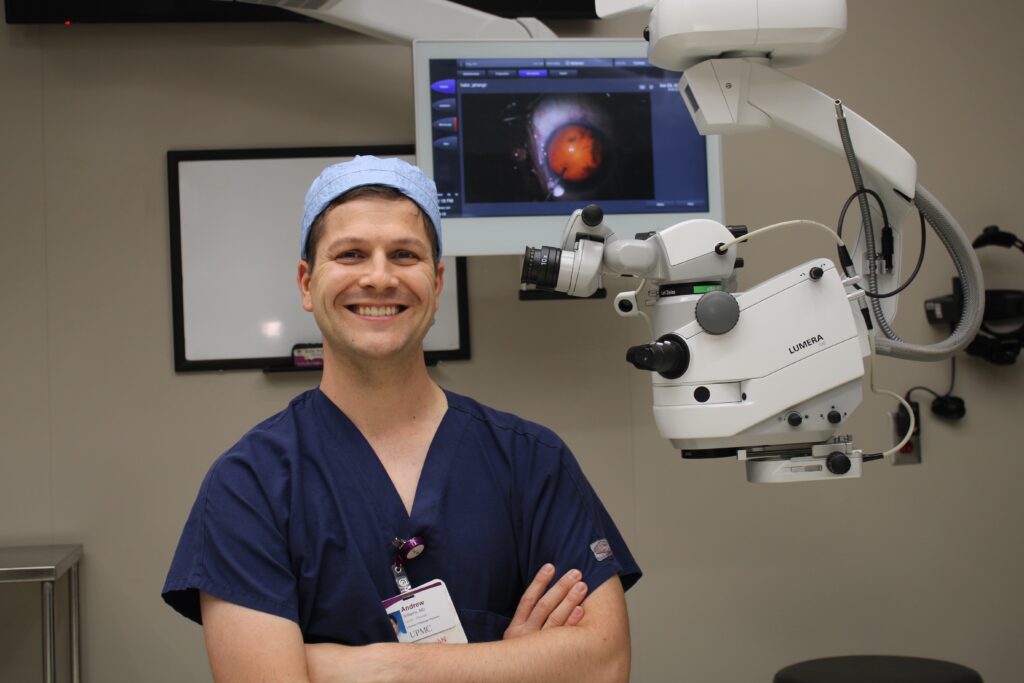
Addressing Social Needs to Improve Access to Eye Care: Andrew M. Williams, MD, and the Healthy Vision Lab
Glaucoma is a challenging ailment to manage. It is typically asymptomatic but discreetly causes irreversible vision loss, usually slowly. The stability of a patient’s glaucoma must be evaluated at periodic intervals with clinical examinations and ancillary testing to assess progression and to ascertain response to treatment. These treatments typically involve some combination of office-based laser procedures, incisional surgery, or one or more eyedrop medications administered at least daily. All therapies require long-term monitoring and regular clinical care. It can be a challenge to motivate patients to keep at it. In fact, many do not.
Andrew M. Williams, MD, has dedicated his research program to understanding and addressing lapses in follow-up, particularly in glaucoma, by bringing attention to social determinants of health that affect access to eye care. As a board-certified ophthalmologist and fellowship-trained glaucoma specialist, Dr. Williams is an Assistant Professor of Ophthalmology and directs the Healthy Vision Lab, an interdisciplinary group of researchers that applies epidemiology and health services research to improve access to eye care. Much of his work has been dedicated to addressing the issues of lapses in glaucoma care, which can lead to undertreatment, disease progression, and irreversible blindness.
Funded by the American Academy of Ophthalmology (AAO) and Research to Prevent Blindness (RPB), with additional support from the Henry L. Hillman Foundation, Dr. Williams has leveraged “big data,” or large national data repositories, to demonstrate the jaw-dropping scope of loss follow-up (LTFU) in glaucoma care, often defined as a lapse of greater than 1 year without an eyecare encounter. In his preliminary research, Dr. Williams found that a third of glaucoma patients at one academic center became LTFU over 10 years, even after censoring those with documented moves or death. These findings prompted Dr. Williams to earn grant funding from the AAO/RPB to discern the prevalence of LTFU among glaucoma patients at a national level. His AAO/RPB grant gave Dr. Williams access to data from the IRIS® Registry (Intelligent Research in Sight), the nation’s largest clinical eye disease registry that receives data from across the United States. In collaboration with Hsing-Hua (Sylvia) Lin, PhD, then a data scientist at the Epidemiology Data Center at the University of Pittsburgh School of Public Health (Pitt Public Health), and two postdoctoral scholars at the Healthy Vision Lab, Lauren Wasser, MD, and Hai-Wei Liang, PhD, Dr. Williams and his team analyzed follow-up patterns for over half a million glaucoma patients from across the country. The results were striking. Over half of glaucoma patients lapsed by a calendar year or more over a 6-year period, and, of those who lapsed in follow-up, only a third ever returned to care after an episode of LTFU. If these IRIS Registry results are representative, half of established glaucoma patients are falling through the cracks.
Dr. Williams found that not only is LTFU highly prevalent in glaucoma care, but that it also disproportionately affects the most vulnerable patients. Moderate- or severe-stage disease severity at baseline (compared to mild-stage), visual impairment or blindness, older age, nonwhite race, and Hispanic ethnicity were significant risk factors for LTFU in an adjusted analysis of IRIS Registry data. These findings suggest that patients at greatest risk of glaucoma progression are the ones at greatest risk of lapsing in care. More concerning still, among the cohort of patients with LTFU, most of these characteristics were also risk factors for nonreturn (rather than re-establishment of care after a lapse). The glaucoma patients at greatest risk of visual disability from their disease are the ones we are losing from clinical care.
Does LTFU Matter?
Dr. Williams has demonstrated that lapses in glaucoma care are associated with poor outcomes. Using data from one academic center, he found that two-thirds of glaucoma patients who returned after a period of LTFU returned with disease progression or a late surgical complication. His recent article from the IRIS Registry data compares 6-year outcomes between glaucoma patients with lapses in care and glaucoma patients who completed a visit at least annually. In this adjusted analysis, LTFU was independently associated with increased risk of incident blindness. Specifically, compared to patients with consistent annual follow-up, patients with a lapse in care of 1-2 years had 19% greater risk of incident monocular blindness by the end of the 6-year period, and those with a lapse of 3-4 years were 2.17-times more likely to go blind, after adjusting for other risk factors for blindness. Going a few years without glaucoma care may double the risk of going blind.
Why Do Patients Become LTFU?
Understanding the reasons behind LTFU is a key step in helping patients to maintain glaucoma care. Dr. Williams obtained grant funding from the American Glaucoma Society to ask patients directly about their reasons for missed visit and their barriers to glaucoma care. He collaborated with Todd Bear, PhD, Director at the Office of Health Survey Research at Pitt Public Health, to design the outreach survey and to engage with a professional call center team to maximize potential engagement. These telephone interviews of glaucoma patients who recently had an appointment no-show, which may precede LTFU, revealed that transportation difficulty was the most commonly cited barrier to care (29%), followed by difficulty keeping track of the appointment (26%) and scheduling issues (12%). Half of respondents screened positive for at least one social risk factor — including food insecurity, housing instability, and financial instability — highlighting the underlying burden of social determinants of health among glaucoma patients with a missed appointment.
How Can we Address LTFU?
LTFU among glaucoma patients is common and consequential, but proactive engagement with vulnerable patients can reduce their risk of lapsing in care. Patient education is important to ensure understanding about glaucoma and to convey the importance of regular follow-up. For patients at risk of LTFU, Dr. Williams has found that reminder messages and outreach can help to make glaucoma care salient, and referrals to assist with social needs may address more pervasive barriers to care.
Sending reminder messages or phone calls in advance of an upcoming appointment can reduce risk of no-show. In the same vein, outreach after an appointment no-show can promote re-engagement in care. Specifically, Dr. Williams’s group found that sending a standardized patient-portal message through the electronic health record (EHR) within a business day of an appointment no-show doubled the odds of a patient attending a rescheduled appointment within 30 days. Similarly, phone calls or messages to reengage glaucoma patients after LTFU may motivate them to reschedule overdue follow-up visits; a medical student-led project is currently underway at the Healthy Vision Lab to do just that.
More robust interventions could address underlying barriers to care, starting with universal screening for health-related social needs. These needs cannot be addressed if the eye care team is unaware of them. To bring social needs to ophthalmologists’ attention, Dr. Williams established an EHR-integrated screening intake for outpatient ophthalmology encounters at the University of Pittsburgh in April 2023. Research into the outcomes of this universal screening has revealed that 1 in 7 patients indicate at least one health-related social need, such as difficulty with medical transportation. By asking about social needs, ophthalmology teams can initiate a discussion about individual barriers to maintaining eye care, such as transportation and medical costs. Moreover, identifying unmet social needs can facilitate referrals to local resources, such as patient navigator or social work programs. An ophthalmology patient navigator program at the University of Pittsburgh resolves about 90% of referrals to address barriers to eye care — most commonly transportation needs or insurance issues—with high patient satisfaction. Other departments could benefit from similar models or from making available information for local resources and assistance programs. Identifying and addressing social needs in the eye clinic may reduce barriers to care and promote long-term follow-up.