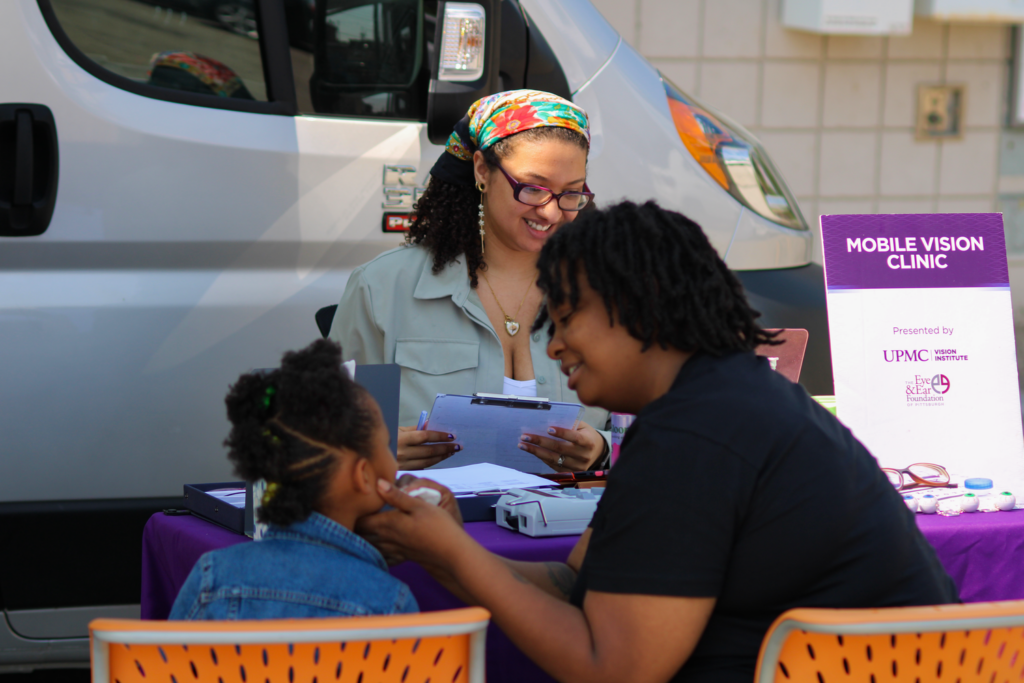
Remote care is revolutionizing eye health by making services more accessible and equitable for all.
Eyes on Wheels
Eyes on Wheels is a dynamic, student-run mobile health clinic committed to breaking down barriers to eye care in Western Pennsylvania. Founded as Guerrilla Eye Service in 2005 by Evan “Jake” Waxman, MD, PhD, and medical students at the University of Pittsburgh, the program provides free, comprehensive eye exams to those facing obstacles to care, while giving medical students invaluable hands-on experience early in their training.
Each month, Eyes on Wheels embarks on three outreach missions to local community clinics, including Birmingham Clinic, Squirrel Hill Health Center, East End Community Health Center, McKeesport 9th St. Clinic, and others in Butler, Waynesburg, and Greensboro. Sites are visited outside of regular business hours, making vision exams more convenient to access for working professionals and parents.
Reducing Preventable Vision Loss through Simple, Accessible Diabetic Retinopathy Screening
Beyond regular clinic missions, Dr. Waxman’s team has deployed around 50 web-connected retinal cameras in primary care clinics and community organizations throughout Pittsburgh. These easy-to-use devices empower onsite staff to quickly identify at-risk patients and capture retinal images. Ophthalmologists at UPMC Vision Institute review the images and relay follow-up reports and treatment recommendations to community health providers for patient discussions. This innovative program now produces over 7,000 images annually, reaching thousands who otherwise might never see an eye doctor.
One of the most profound impacts of remote care is its potential to break down barriers to access. Rural communities, underserved urban populations, and individuals with mobility challenges often struggle to receive timely eye care. Teleophthalmology bridges this gap, enabling patients to connect with specialists regardless of location. Mobile eye units, equipped with diagnostic tools and internet connectivity, bring care directly to those who need it most.
Remote care also fosters equity by reducing the financial and logistical burdens associated with in-person visits. Patients save time and resources, while clinics can reach a broader, more diverse patient base. In addition, remote platforms facilitate interdisciplinary collaboration, allowing experts from different regions to consult on complex cases.
eyeVan
The Vision Institute also utilizes a fully equipped mobile eyeVan that was donated in 2023 by the Brother’s Brother Foundation to assist Dr. Waxman and the Eyes on Wheels team in providing free community vision clinics in the Pittsburgh region. Outfitted with advanced medical technology, this doctor’s office on wheels brings comprehensive eye exams, screenings, and treatments directly to individuals in underserved neighborhoods, further eliminating barriers to essential eye care.
The eyeVan partners with senior centers, federally qualified health centers, and other nonprofit facilities to deliver services to older adults. While the eyeVan was originally established to serve seniors, through getting more engaged in the community, it became apparent that there was a huge need to serve children too. The eyeVan also coordinates glasses drives.
As of early October, the eyeVan has provided eye exams to 377 patients, of whom 183 were new and 42 were returning. Seventy-four were uninsured, 87 were male and 168 were female. Sixty-four required follow-up visits at the Vision Institute while 56 received follow-up at their facility. Glasses were ordered for 281.