William D. Smith III, OD, Director of Low Vision/Vision Rehabilitation Services at UPMC, offered up a great tip at the start of the Eye & Ear Foundation’s January 16th webinar, “Living with Low Vision.” If you have an appointment with the Low Vision Division, drive to the roof level (P8) of the Mercy Pavilion parking garage. A doorway there will lead right into the waiting room.
UPMC Vision Institute
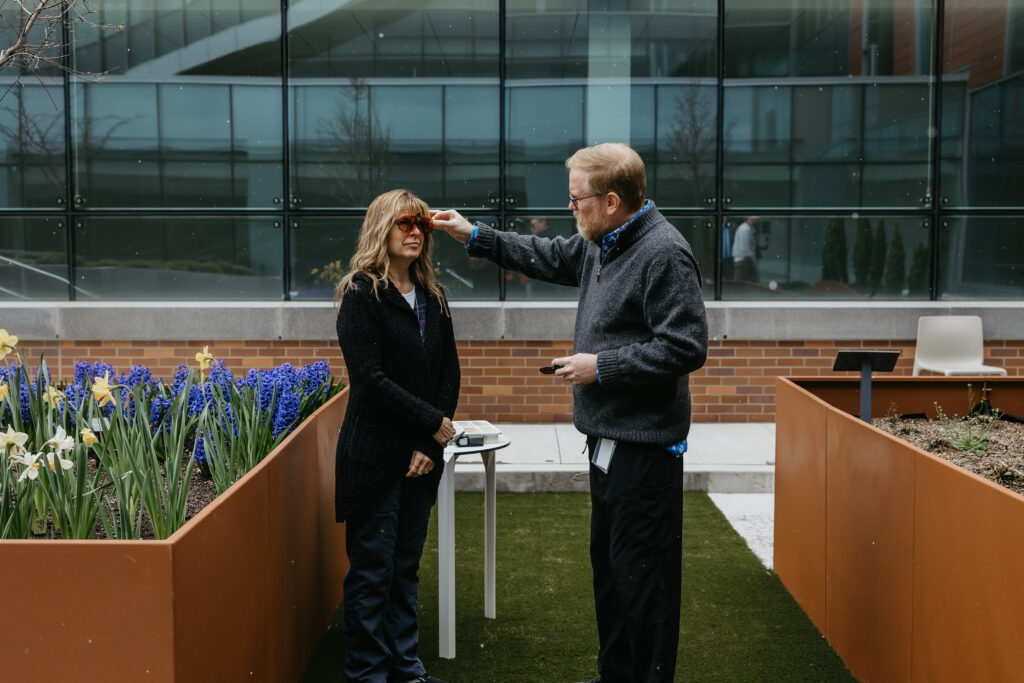
Dr. Smith talked about how the Vision Institute (VI) was designed with patient experience in mind. The Low Vision suite is contained; once patients are there, they do not have to move anywhere else. The VI has specialized rehabilitation areas where low vision services can be utilized, like the Low Vision Rehabilitation Garden and Life Skills Apartment.
Services the Low Vision Division provides include:
- Comprehensive LV evaluations
- Intensive LV rehab
- Bioptic driving evaluations/assessments
- Educational assessments/recommendations
- Occupational assessments/recommendations
- Community re-integration
- Referrals to local and state agencies
- Research
- Retinal Dystrophy Clinic
- Genetic counseling
The Low Vision Division has a team approach that utilizes state-of-the-art low vision devices and technologies. They serve all age ranges and address educational, occupational, safety, and quality of life. Team members include a residency trained low vision optometrist, an occupational therapist (there are four) with advanced training/certification in low vision rehab, and a low vision optometry resident. They also collaborate with community agencies like VAMC, OVR, and BVS.
Basic Anatomy
Vision loss can happen at any point within the eye. The risk of vision loss increases substantially with age. Causes include cataracts, glaucoma, macular degeneration, diabetic retinopathy, and genetic causes like albinism or retinitis pigmentosa.
Visual impairment/low vision is a reduction in vision that cannot be corrected with standard glasses, contact lenses, medications, or surgical interventions. It reduces a person’s ability to function at certain or all tasks. It includes:
- Inability to see images clearly and distinctly
- Loss of visual field
- Inability to detect small changes in brightness
- Color blindness
- Sensitivity to light
Low Vision Evaluation
In a low vision evaluation, goals will be defined, visual function measured, and functional visual performance compared. The team will evaluate and recommend devices/rehabilitation to meet visual needs and goals.
Specialized visual acuity measurements are used, along with specialized measurements of color vision. This includes measuring contrast sensitivity, which is often overlooked in a lot of visual measurements and can be one of the major components of why someone is having trouble seeing.
Distance
If someone has difficulty seeing things in the distance, assistive devices depend on whether the patient needs help with spotting things, like bus numbers, signs, or a chalkboard. Tools used might be a monocular handheld telescope, binoculars, or a bioptic spectacle mounted telescope – a telescope that is mounted permanently in a pair of glasses. If someone needs help for a longer, sustained period of time, like if they are watching TV or a movie, binoculars could help here too, or a full-field spectacle mounted telescope. IrisVision is another tool; it creates a digital image that is viewed on special glasses/a virtual reality headset (depending on the device). Dr Smith said it is important to look at the device before purchasing, because some things work better for certain conditions or levels of vision loss. The team will help guide recommendations.
Driving
Bioptic driving has been approved in PA. The requirements to obtain a permit are:
- An individual with VA less than 20/100 combined visual acuity but at least 20/200 visual acuity in the best corrected eye
- Color vision sufficient to respond correctly to traffic signals
- Proof of having a prescription bioptic telescope lens system
- Provide a letter of enrollment with Low Vision Rehabilitation
- Bioptic telescope power cannot exceed 6 x and must be fixed into spectacles
Once a permit is obtained:
- 20 hours of behind the wheel driver’s training
- Must complete a minimum of 45 hours of observed driving hours with a licensed driver who is at least 21
- After completed, will be re-evaluated by low vision rehab professional and then recommended for on-road examination
There are still restrictions with a permit:
- No freeway driving
- Vehicles weighing no more than 10,000 pounds and excludes motorcycles
- Daylight only if VA through telescope is less than 20/50
- Nighttime driving application can be made after 1 year on road with a VA of 20/40 or better through the telescope
- Professional may limit driving to a limited radius of a person’s residence
More Low Vision Tools
For spot reading and things that are nearby, illuminated handheld magnifiers can help. Dr. Smith said it is important to keep in mind that the larger the magnifying lens, the weaker that lens is.
Another option is to get a pair of very strong reading glasses with a special lens in them called PRISM. The print has to be held closer to the face. Often, this is used as a first round option because it is more natural.
A digital magnifier is a magnifier placed on the reading material. It has an adjustable range of magnification and allows for the size, background, and contrast to also be modified.
Stationary models like closed circuit televisions are useful for long-term reading. You could even put your hands underneath the screen to clip your fingernails if you are having trouble.
For intermediate vision, loupes like jewelers use – head loops with strong lenses – are helpful. Reading stands, lighting, and non-opticals are other strategies.
DynaVision is a tool used in rehabilitation; it is a large black screen with what look like buttons that are illuminated when the machine is on. It helps with scanning, tracking, and localization, especially for those who may have had a head injury or stroke. It works to expand the visual field.
BITS works similarly, but with more visual-perceptual issues. If someone has had a stroke and knows what things are but are not able to figure out what they are based on a picture, this device can help with that.
There is technology to help with functional communication, GPS and wayfinding, financial, medical, and health self-management. An app called Seeing AI, which is free and only available on IOS, has optical character recognition. It reads short text, currency, and handwriting, describes the scene or person, and identifies color and lighting.
Occupational therapy low vision interventions include Zoom Text computer magnifier and reader. Another one called Fusion has text-to-speech. Jaws will read what is on the computer.
Occupational Therapy Low Vision Evaluation and Strategies
An occupational therapist (OT) will use LuxIQ to look at the wattage and temperature to determine whether you see better with cooler or warmer temperatures and how that can be integrated into your living environment. A functional lighting assessment is done, with glare control and contrast enhancement. Tinted filters that fit over glasses are used mostly for indoors. Another kind of glasses that are darker, which are used outdoors. OTs can assess patients with specially tinted contact lenses.
Suggestions for mobility safety and daily tasks are shared, like color contrasting stairs to prevent falls, a liquid indicator on a mug that makes a sound when it is full. Newer technology like text-to-speech is making the rounds now. Ray Ban has Meta AI glasses that work similarly to Siri or Alexa. A camera is built in, and you would say, “Hey Meta, look and tell me what is in front of me.” It would then describe the room you are sitting in. This tool would not assist in seeing better but is a tool that can help with safety and confidence.
OrCam attaches to a pair of glasses via a magnet. You tap the side of the device or point your finger out. It reads text, labels, mail, and books.
One thing the Division is actively working on is getting a psychologist who can talk with patients experiencing vision loss and lead support groups. “It is often very traumatic to lose your vision,” Dr. Smith said. “We want to make sure we’re focusing on how to help navigate that. How people feel is very important.”
Research
The Prima study was done for patients with macular degeneration. A retinal implant, it uses specialized glasses to enhance and improve vision. This is more along the lines of vision restoration.
Work is being done to prevent vision loss progression and to slow it down. Gene therapy is another hot research area. This involves trying to help restore or change the function of cells in the back of the eye to do a different task to help patients gain better visual performance.
The GenSight study is an intraocular injection combining gene therapy and optogenetics. It uses gene encoding for a light sensitive protein into the ganglion cells, making them responsive to light and bypassing damaged retinal layers.
Genetic counselors can verify gene defects in patients, which will open them up to potential studies.
“There has been a lot of progress [in the field of vision loss] over the last 10 years,” Dr. Smith said.