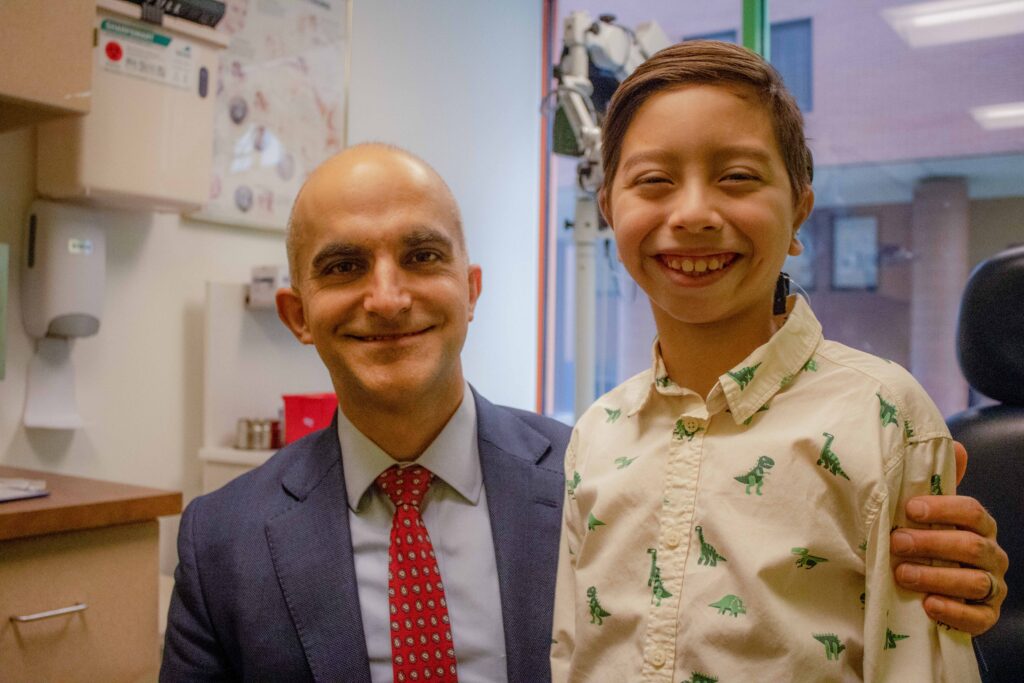
A nine-year-old boy born without external ears or ear canals now has two functional ears, thanks to Noel Jabbour, MD, MS, FACS, Director of the Congenital Ear Center at UPMC Children’s Hospital of Pittsburgh. To Dr. Jabbour’s knowledge, this may be the first bilateral microtia reconstruction of this type performed in the United States, with prior cases reported in England and China.
Traditionally, bilateral reconstruction required at least four separate surgeries. This newer approach – which included a bilateral rib cartilage graft – allows for a full reconstruction of both ears in just two surgeries.
While the 13+ hour surgery makes for a long day, there are other unique advantages to doing both ears on the same day. The patient only has to endure the first stage once, which is the most painful as it involves rib removal. “The other advantage is because we’re borrowing tissue from both sides, sometimes the contour of the rib makes a better right ear or a better left ear, and we can then mix and match the parts to make the best fit to create a really symmetric sculpture from both sides,” Dr. Jabbour said. “It’s an excellent mirror image of one ear to the other ear; we can get both the shape and positioning as close to a perfect match as possible.”
Having bilateral microtia and aural atresia is a significant aesthetic and functional deformity, and a challenge for the patient’s hearing and learning if the hearing is not habilitated. “To be able to address both of those in a condensed timeline is really valuable for the patients,” Dr. Jabbour said. “I’m glad that we can offer that here at Children’s Hospital of Pittsburgh.”
The surgery was a team effort and actually took less time than two separate individual surgeries. Fellows and residents learned and worked with Dr. Jabbour, who called them crucial to being able to do this type of surgery.
Another aspect that made Dr. Jabbour’s job easier was the ability to utilize UPMC’s 3D Printing Program. He collaborated with bioengineers to design the cutting guides used for the surgery as well as 3D models of the ribs and ears.
Dr. Jabbour reports that the patient is thrilled to have two ears and is very happy with his facial symmetry and the appearance of his ears. He is also very happy to have his Osia implants from Cochlear, which allow him to hear sounds.
“This is an important clinical milestone for our program at CHP,” Dr. Jabbour said. “We are now able to offer bilateral microtia patients a more streamlined surgical plan with strong functional and aesthetic outcomes.”