Do you have difficulty breathing in your throat during times of intense physical activity? Does it resolve soon after with rest?
If you live in the Pittsburgh region, answer yes to these questions, and are under the age of 26, you would likely be referred to the Pediatric Vocal Cord Dysfunction Clinic (VCD) at UPMC Children’s Hospital of Pittsburgh.
The only clinic of its kind in the region associated with physicians, it was started in 2010 by Raymond Maguire, DO, along with speech language pathologists and pulmonologists. Dr. Maguire found a need for a more organized, pre-planned way to provide comprehensive care for this population.
So now, on the first Tuesday of every month, the VCD clinic at Children’s evaluates patients for vocal fold dysfunction and provides training on breathing techniques. Vocal cord dysfunction has gone by many different names over the years, including paradoxical vocal fold movement disorder; the most current term is inducible laryngeal obstruction (ILO). Vocal cord dysfunction is the easiest for patients to understand.
What can this problem look like? The young person may be participating in a sport or other activity, exerting themselves, and develop difficulty breathing in their neck because their vocal cords abduct, or close. Stridor or wheezing can be heard during these episodes. This will resolve with rest, typically after about five minutes. This condition is often confused with asthma, but they are quite different.
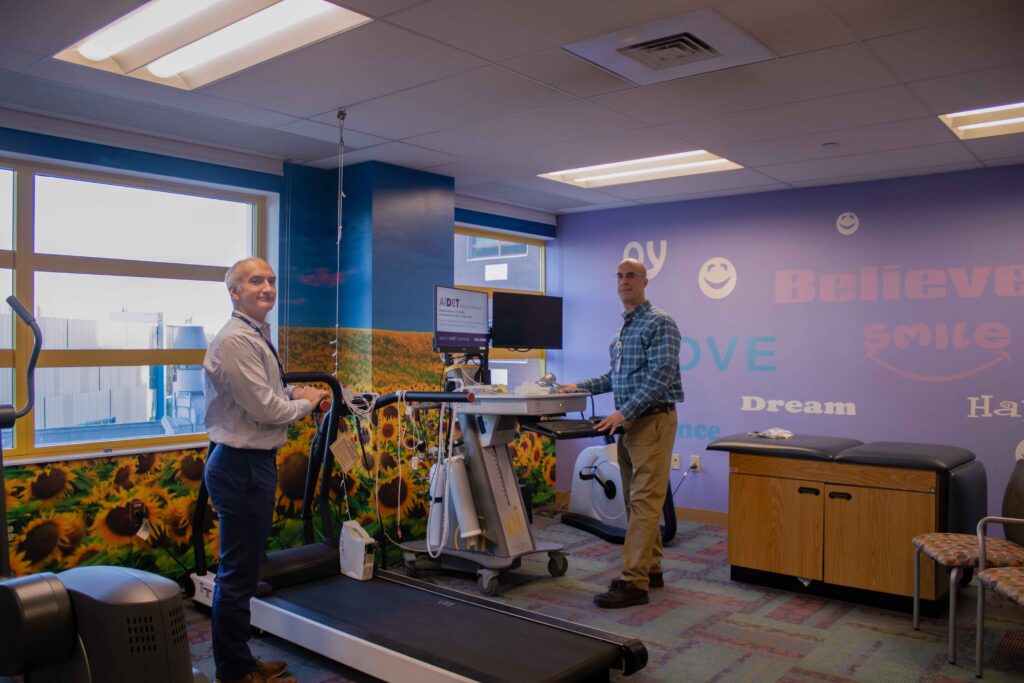
The center has the capacity to run three exercise tests per clinic. Paul Rebovich – the pulmonary exercise physiologist with a Masters of Science in Exercise Physiology – runs pulmonary function tests both before and after the patient runs on the treadmill, while connected to an EKG, in an attempt to trigger the breathing difficulty. Live flow volume loops show the rate of airflow going in and out of their lungs allowing as a way to indirectly assess the vocal folds. As soon as the patient reaches their limit or becomes symptomatic, they stop. Dr. Maguire then performs a flexible nasal laryngoscopy to look at their vocal folds as part of a full assessment. Following this, further pulmonary function tests are performed, and then the patient receives a treatment of albuterol and completes the testing. This is the protocol to assess for exercise induced asthma; that diagnosis is determined by the pulmonologist.
The patient will then be interviewed and examined in the clinic, where they discuss all their symptoms, what they are feeling, and be educated on the disorder.
The good news is the primary treatment is not medication or surgery; it is speech therapy, which helps retrain the vocal folds to remain open during times of stress and exertion. If the patient is diagnosed with the issue, a breathing strategy session is offered that day by the clinic’s primary speech language pathologist, Katherine E. White, MA, CCC-SLP. There is an open invitation to call with questions, and further virtual or in-person speech therapy sessions are offered as needed. Less than 10% of patients ever call and need a refresher.
It is important to learn and understand these breathing techniques. “This is a scary event because they’re athletes who want to breathe and excel,” Dr. Maguire said. “They have other stresses. They’re usually straight A students and have high aspirations with lots of pressure on them. I take the time in the office to educate them on their vocal folds. Even though these are super intelligent individuals, they have no idea what their vocal cords are supposed to be doing or why this is happening. Having this discussion actually gives them a sense of security.”
While there can be underlying factors, primarily the VCD deals with otherwise healthy patients. They learn that the condition is multifactorial with triggers that are different for each person. Dr. Maguire said what makes the clinic special is the ability to reassure patients that they are not alone and will not die from this.
The VCD clinic sees more than 75 patients a year. In addition to Dr. Maguire, Daniel Weiner, MD, from the pulmonary medicine department, aids in the treatment of these patients. Dr. Maguire and his team are in the process of developing a pediatric oriented questionnaire for Vocal Cord Dysfunction/Inducible Laryngeal Obstruction so they can assess the outcomes and ensure these patients are properly treated.
“One of the reasons why I like this so much personally is I have been a coach and athlete since I was in high school,” Dr. Maguire said. “I currently am a level 4 ice hockey coach for a local travel team. I’ve participated and completed multiple long-course triathlons throughout my life. So, I feel for these individuals. We share this commonness, which helps me bond with them and helps them understand that I get it.”
To schedule an appointment with the VCD clinic, call Mario Balestreri at 412-692-3340.