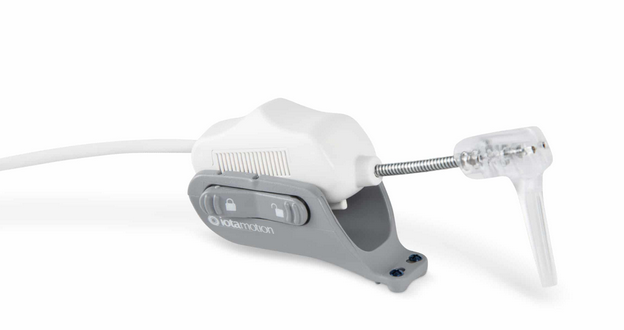
Starting in March, the Department of Otolaryngology-Head & Neck Surgery will be offering robotic-assisted surgery for cochlear implantation at UPMC Mercy/Shadyside.
A robot handling an intricate part of anatomy? As paradoxical as it sounds, the iotaMotion robotic system is actually less invasive and more beneficial, with no additional cost to the patient.
“At UPMC, we use the most advanced implant technology available, along with medications and techniques designed specifically to protect hearing,” said Peter Santa Maria, MD, PhD, Division Chief of Otology & Neurotology. “The iotaMotion robotic system allows us to place the implant more slowly and gently than ever before. That precision helps us better protect delicate inner ear structures and gives our patients access to the most advanced hearing care available anywhere.”
Robotic-assisted surgery has additional benefits. “When we place a cochlear implant, one of our biggest goals is to protect the hearing a patient still has,” Dr. Santa Maria added. “If we can preserve their low-pitch hearing, they get the best of both worlds — clearer speech from the implant and the fuller, warmer sound that helps with music and natural voice quality.”
There is also new clinical evidence emerging highlighting the positive impact on audiological outcomes, according to iota.
Ironically, iota – a growing medical robotics company based in St. Paul, MN – has an innovation hub in Pittsburgh, which opened prior to the Department receiving approval.
Pittsburgh will now join 34 other clinics across the U.S. that offer this technology. It is available to use in patients four years and older, so Children’s Hospital of Pittsburgh is hoping to receive approval as well.
When will the Department start using iotaMotion? “As soon as the first patient is booked,” said Dr. Santa Maria.