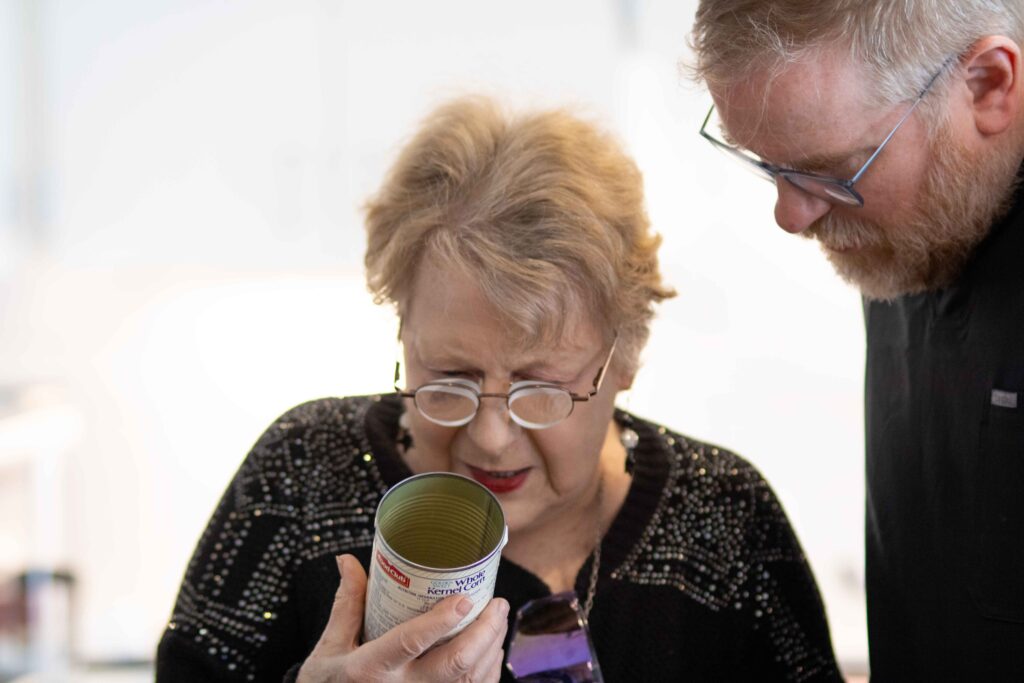
Twelve years ago, Patty Azocar’s daughter – a nurse in Arizona – saw a paper that William Smith, OD, had written. She told her mom that she and Dr. Smith were both in Pittsburgh. So, Patty, who has been legally blind since she was 13, made an appointment.
She has been Dr. Smith’s patient since.
“I have had really wonderful doctors, but no one ever really helped me the way Dr. Smith has,” the now 81-year-old Patty said. “He has done many things for me to be able to see, which seemed impossible, especially at my age.”
Patty’s eye condition is called Stargardt maculopathy. According to the Foundation Fighting Blindness, “Stargardt disease is a genetic eye disorder that causes retinal degeneration and vision loss. [It] is the most common form of inherited macular degeneration, affecting about 30,000 people in the U.S.”
The first thing Dr. Smith, Division Chief of the Low Vision Service, did was make Patty a pair of microscopic reading glasses. They equilibrate to about a 32-diopter lens, allowing her to read on the phone and be more independent.
The second thing Dr. Smith did, which Patty called a miracle, was to give her specially tinted contact lenses called biomedic contacts. They reduce glare and improve contrast sensitivity. In order for her to get around safely and detect objects, Patty has also worn a gray green tint, which helps her in brighter lighting conditions. She especially likes that they help her find things at the grocery store. Even better, if she puts a pair of reading glasses over them, she can actually read the ingredients on the package.
Dr. Smith also introduced her to IrisVision, an FDA-registered wearable device that is basically a pair of augmented reality goggles. Its magnification system can be used to view things far away as well as up close. Patty wears them to watch TV, make jewelry, and read. She said it helps her to see 20/30. “You cannot walk with this thing on,” she said, “but if you have to see something, you can. That, to me, is a miracle.”
When Patty had cataract surgery, Dr. Smith found lens to increase her peripheral vision and put a filter in them. It is actually thanks to Dr. Smith that Patty underwent gene testing and discovered that Stargardt disease caused her vision issues. She credits him for going above and beyond. “I’m just so grateful to that man for all the outside the box things he’s done to help me see, even at this late stage of my life,” she said.
Dr. Smith had Patty use all her devices in the Life Skills Apartment to “help ensure that what we’re doing in the clinic is meeting her visual needs in a real-world setting.” She also participated in a research study with IrisVision that worked on looking at vision and dexterity. Additionally, Patty worked with the Human Balance and Movement Lab at Pitt to ensure that these devices were meeting her needs at home.
Prior to this, Patty had been having difficulty with digital appliances. She used to put a rhinestone sticker on the 350-degree mark on the oven, so she could feel it and know the oven was at the right temperature. In this digital era, she cannot feel what the numbers are saying. Real damage could be done if the wrong button is pressed. Now she just utilizes IrisVision.
Dr. Smith described Patty as a patient who is “very willing to evaluate any device with enthusiasm to help address her visual needs and goals. She’s very positive and has an excellent attitude in accepting alternative ways of seeing, which has made her extremely successful with her low vision devices.”
With Stargardt disease, Patty’s vision progressively worsens. “But it seems every time it decreases, Dr. Smith does something to make it more tolerable,” she said.
She thinks the world of Dr. Smith, Dr. Sahel, and the Vision Institute. “I’m so glad it’s there,” Patty said. “Nothing has ever helped me this much in my life. It’s great to be able to pay my bills, see what I’m writing, find what I’m cooking, and all that stuff. It’s a real comfort.”