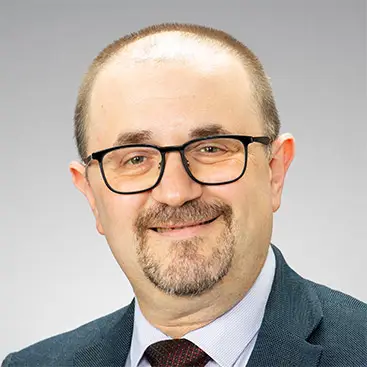
The lab of Boris Rosin, MD, PhD, focuses on the neuronal activity correlates of visual disability, both in the retina and the central nervous system (CNS), and their implications for vision rehabilitation following therapy.
“We know for a fact that any form of visual disability results in profound changes of the visual circuitry of the CNS, which forms the basis for a phenomenon called amblyopia (lazy eye),” Dr. Rosin said. “Furthermore, our own research suggests that this circuitry remodeling occurs even at the level of the retina itself, with marked changes in inner retinal (intermediate cells) circuitry and activity.”
The lab is working on employing various rehabilitation strategies aimed at improving the retinal and CNS circuitry activity as a means to improve rehabilitation and treatment outcomes. Potential applications and implications for human patients are profound, Dr. Rosin said, as they pertain to approaches to visual rehabilitation after treatment of essentially any visually debilitating disorder.
They have identified potential targets in disorders of several models. These include RCS rats, which are a naturally occurring model of retinitis pigmentosa (the most common retinal dystrophy) and optic nerve sheath preserving transection – a model for optic neuropathies such as traumatic optic neuropathy or glaucoma. Experiments employing these models in post-treatment rehabilitation approaches are underway.
The lab enjoys several important collaborations. They work closely with Dr. Byrne’s lab, which has been helpful in the development of viral vectors for the treatment of different dystrophy models via gene therapy. They have substantial collaborations with the labs of Drs. Kuwajima, Chang, and Aldiri, looking at developmental disorders affecting optic nerve function. The lab is also part of the ARPA-H THEA (Transplantation of Human Eye Allografts) initiative, a joint venture of many scientific groups at Pitt and Stanford, aimed at achieving the ambitious goal of transplanting a human eye.
As with any lab in its initial steps, funding is the greatest need. Through funding, Dr. Rosin said they can employ additional personnel, improve scientific throughput, and get faster answers to the questions they investigate. It also allows them to pursue additional projects and create new collaborative efforts with other researchers/centers.
Dr. Rosin called the Vision Institute a unique model of ophthalmic research, with a “phenomenal” research atmosphere there and at Pitt, “with world class research, medicine, and amazing breakthroughs being developed, practiced, and achieved on a daily basis.”