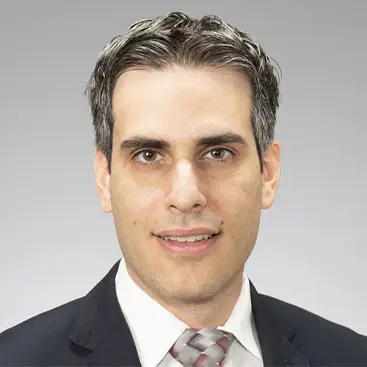
Dr. Joseph Martel’s work focuses on inherited retinal diseases (IRDs), a group of rare, often devastating conditions that cause progressive vision loss and for which there have historically been no treatments.
The Division Chief of Retina and Vitreous Services is actively involved in investigating potential treatments for rare IRDs such as gene therapies.
“We are also one of the Centers of Excellence providing administration of the first and currently only FDA-approved ocular gene therapy, LUXTURNA, for RPE65-associated retinal dystrophy,” Dr. Martel said. “The promise is real: for the first time, we can offer some of these patients the possibility of preserved vision with continued work toward vision restoration. That said, we are still in the early chapters of this story. Many IRD subtypes remain without any treatment, delivery methods continue to need refinement, and vision restoration solutions for very advanced retinal degenerations are being investigated. There is a tremendous amount of work still ahead.”
The IRD clinical trial program is one of the more active in the country, with multiple ongoing trials including PRODYGY (SPVN06 for rod-cone dystrophy), VISTA (Beacon Therapeutics for XLRP), PRIMA (bionic vision), and optogenetic vision restoration clinical trials.
Next steps include expanding the trial portfolio with additional gene therapy products as well as cultivating other vision restoration approaches, like cell-based stem cell therapy, artificial retina, and whole eye transplantation. The team is also involved in advancing a novel gene delivery program by investigating gene therapy carrier platforms and vectors, as well as early work with robotic-assisted subretinal gene therapy delivery in collaboration with Carnegie Mellon University.
Collaboration is central to this work, Dr. Martel said. Locally, he works closely with the Carnegie Mellon University Robotics group (Dr. Cameron Riviere) on handheld vitreoretinal microsurgery, and with Lions World Vision Institute on retinal tissue studies. Nationally and internationally, he collaborates with leading scientists, including Drs. Byrne and DiLeo at the University of Pittsburgh. “And of course, our connection to Dr. Sahel and the Paris group has been invaluable – both scientifically and in terms of clinical trial access and shared expertise in IRD,” Dr. Martel said.
Continued extramural funding is essential – both NIH and industry support – to advance translational research, particularly the gel-carrier AAV delivery platform and AI-guided surgical robotics work. “Philanthropic support through the Eye & Ear Foundation is also impactful and helps bridge gaps that grants don’t cover,” Dr. Martel added.
Dr. Martel called rare disease work an inherently long game, as these patients often wait years or decades for options. “What keeps it meaningful is seeing the impact,” he said. “Pittsburgh is becoming a real center for this work, and I’m proud to be part of it.”