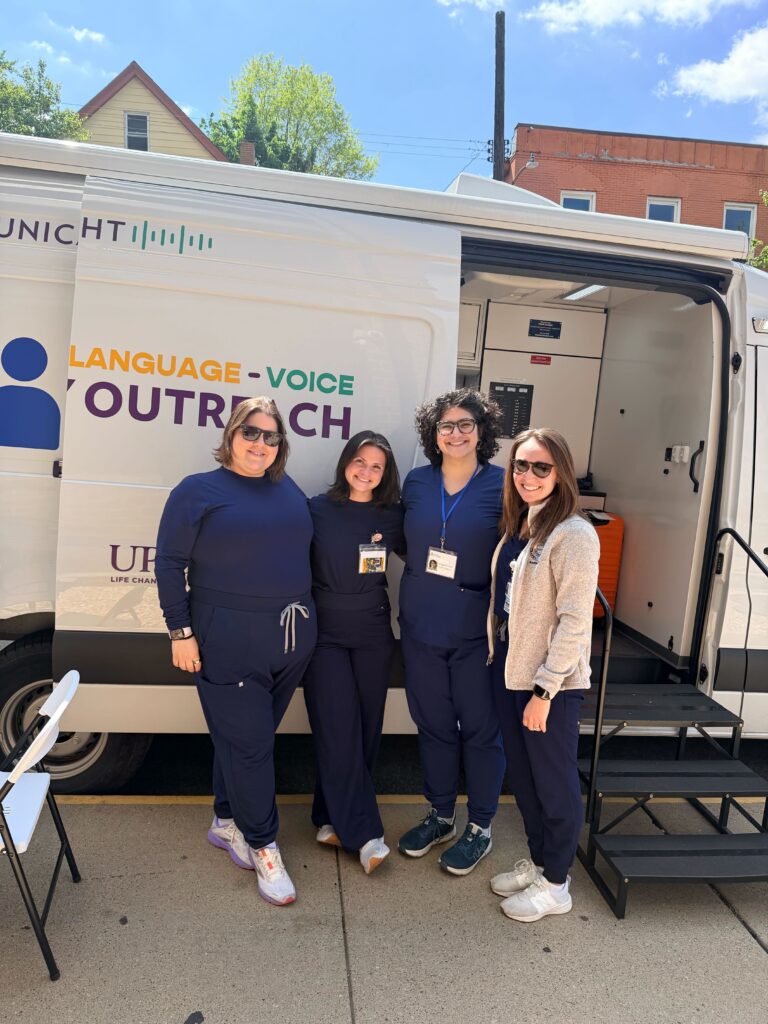
Because the University of Pittsburgh Department of Communication Science and Disorders and UPMC’s Communication Van is much larger and more specialized than a typical vehicle, the team quickly realized that operating it safely and confidently requires training beyond simply handing someone the keys.
The Van is used for community outreach, hearing testing, research, and student education across Pittsburgh and surrounding communities, so “we wanted to create a structured process to make sure faculty, students, and staff feel comfortable driving and operating it,” said Ashley Parker, PhD, Assistant Professor, Director of Research Enterprise and Development, and Director of Field Operations in Pitt’s Department of Communication Science and Disorders. “It’s been a really fun and unexpectedly important part of building the Communication Van program.”
Dr. Parker and Catherine V. Palmer, PhD, Professor and Chair, Department of Communication Science and Disorders, and Director of Audiology at UPMC, stepped up to learn how to drive the Van largely on their own and out of necessity. Early on, Dr. Parker spent time getting comfortable with the vehicle dimensions, turning radius, backing, parking, and navigating Pittsburgh streets in different environments. Since it is a high-roof, long-wheelbase Sprinter, there is definitely a learning curve compared to a normal car, she reported, and even more than that, there are so many controls to operate within the Van to keep it working as an operating mobile lab/clinic. “A big part of it was simply building confidence through repetition and developing operational routines for our events and transport,” she added.
The “driving school” is essentially a hands-on training and operations program for the Van that Dr. Parker has developed into a structured “certification-style” program. It includes orientation to the vehicle itself, driving practice, backing and parking, route planning, safety procedures, setup and shutdown procedures, generator and electrical systems, equipment transport, and day-of operational workflows. They have also developed training materials including quick-reference guides, checklists, and standard operating procedures so the program can scale as more people become involved. There are even required quizzes on the readings before hitting the road, like the written part of a driver’s test. The process is practical and competency-based rather than rigidly time-based.
One of the biggest goals is sustainability. The Communication Van is becoming a major platform for community engagement and accessible hearing healthcare, but also for research. As a result, Dr. Parker said they want to build a team of trained operators rather than relying on just one or two people. “In some ways, yes, it’s less about ‘teaching people to drive a van,’ but it’s also about training people to confidently run a mobile healthcare and research program,” she said.
For the first year, just Drs. Parker and Palmer drove the Van. Now they are actively in the implementation phase, with several faculty members and staff having gone through informal training and supervised driving sessions. As of mid-May, they had doubled the driver pool. Currently there is a core group of trained and/or actively training faculty and staff who can operate the Van for outreach and research activities. This pool is expected to continue growing as the program expands.
In addition to Drs. Parker and Palmer, the Communication Van leadership and operations team includes UPMC Audiologist Dr. Taylor Murray.