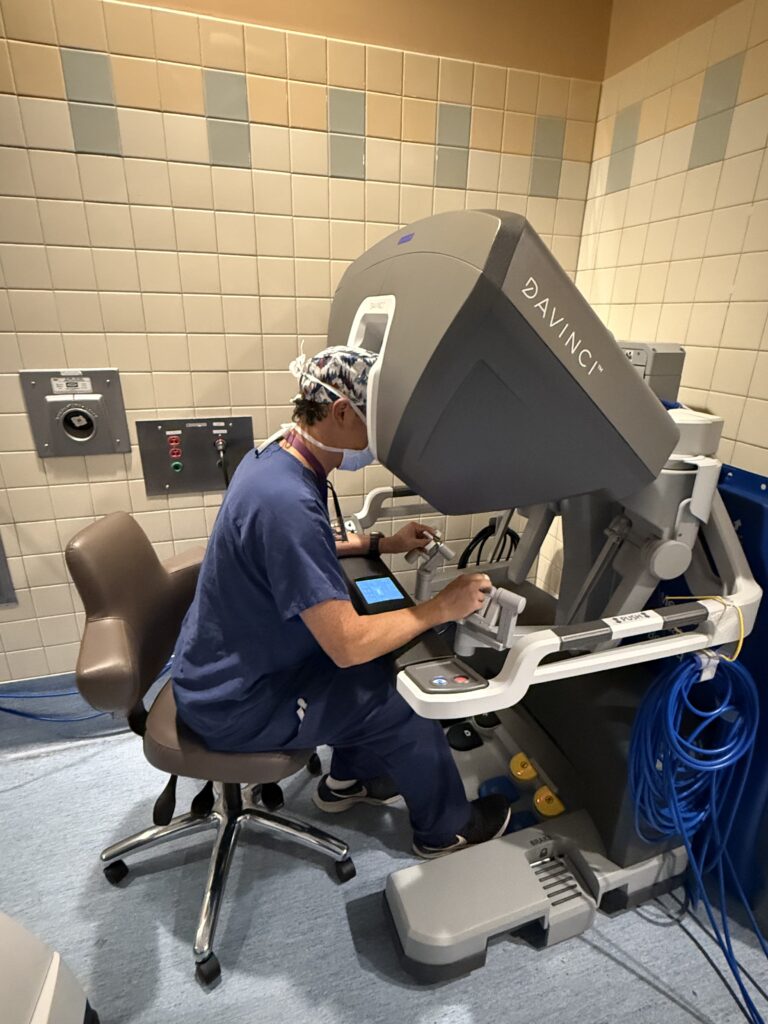
The Department of Otolaryngology-Head & Neck Surgery had its first single-port (SP) Transoral Robotic Surgery (TORS) case in early June. The case actually involved some great Departmental teamwork.
The patient was initially seen by Thomas M. Kaffenberger, MD, Assistant Professor, for severe obstructive sleep apnea. Dr. Kaffenberger completed a tonsillectomy combined with an Inspire hypoglossal nerve stimulator. Then the routine pathology came back positive for HPV+ squamous cell carcinoma.
Dr. Kaffenberger referred the patient to Steven B. Chinn, MD, MPH, FACS, Co-Director of Hillman Cancer Center Head & Neck Cancer Program. The two discussed options to develop an optimal plan to try and treat the patient for the cancer while preserving the Inspire. Dr. Kaffenberger joined Dr. Chinn in the OR to help identify and preserve the implant hardware, which was running just superficially to the lymph nodes that needed to be removed. Equipment was set up in case the lead had to be removed and replaced the same day.
“We had plan A, B, and C, given how unusual of a case it was,” Dr. Kaffenberger said. “We certainly didn’t want to sacrifice or skimp on any of this patient’s care, but we also saw a possibility of treating his cancer while preserving his long-term sleep apnea treatment. Thanks to Steve and his team, we were able to get the lymph nodes out while also preserving the Inspire hardware. We tested the Inspire device before and after surgery, and it was working great.”
Used in the surgery was the da Vinci SP, which is the latest generation of the surgical robots used for TORS. Unlike the older multi-port system, the SP uses a single 2.5 cm port through which three fully articulating instruments and a stereo-endoscope camera are used all through the mouth to gain access to the tumor. The surgeon operates from a console with a magnified, high-definition 3D view and real-time instrument control.
“I would argue the articulating camera allows us to see around corners and not just rely on line of sight and the HD nature allows excellent visualization to allow safe yet appropriate oncologic surgery,” Dr. Chinn said.
Before TORS existed, removing oropharyngeal tumors meant splitting the jaw and making a large neck incision; this led to a more morbid recovery with lasting effects on swallowing and speech. TORS brought surgical time down from roughly four hours to one. The SP advances further, improving precision, allowing for better access and for more patients who qualify for surgery with the goal to de-intensify treatment and reduce long term morbidity associated with standard non-surgical treatment.
While TORS and the SP can be used for a variety of different cancers, its biggest use is in HPV-positive oropharynx cancer (tumor of the tonsil or tongue base), as this is one of the few head and neck cancers still rising in the U.S. These patients tend to be younger, healthier nonsmokers with longer survivorship, which makes minimizing long-term treatment side effects especially important. With TORS, some patients can reduce or avoid chemo and radiation altogether.
UPMC is already nationally recognized for its TORS and hypoglossal nerve stimulation programs. Bringing the SP online here means patients in Western PA now have access to the most advanced version of this surgery, with no need to travel to Cleveland, Mayo, or Penn.
The Department is trying to advance further by integrating the SP with potential clinical trials.