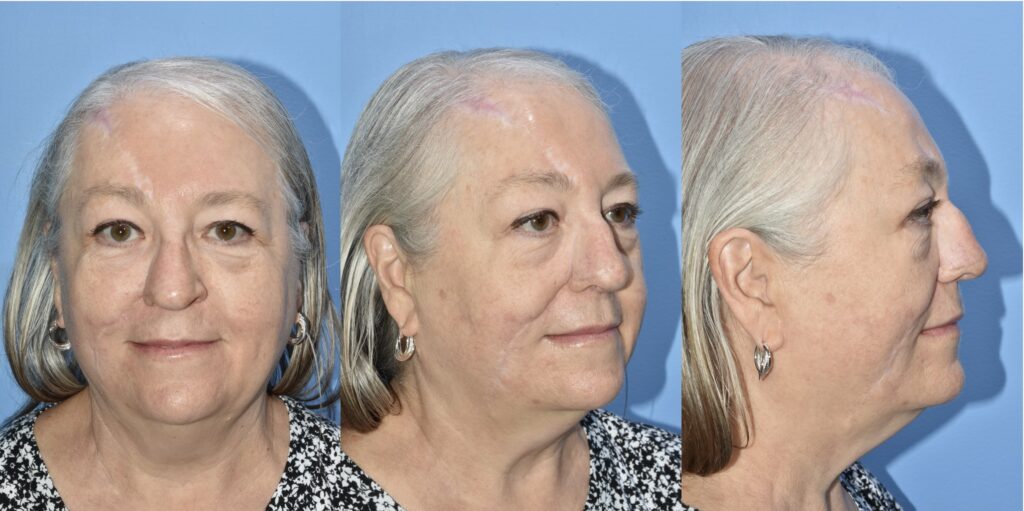
In January 2024, Kathy McClelland, now 73, noticed a bump on the right side of her nose. Turns out it was an intranasal mass that was an adenocarcinoma, an aggressive cancer originating from the mucin-producing cells in the nose.
The Indiana, PA resident was referred to Shaum Sridharan, MD, Associate Professor, Department of Otolaryngology-Head & Neck Surgery, for the initial surgery. Dr. Sridharan then coordinated with Christina M. Yver, MD, MBA, Director of the UPMC Facial Nerve Center, to complete the reconstruction surgery.
Kathy said if it had been up to her to choose a surgeon, she would have still gone with Dr. Yver. “It was a blessing to be in her care,” she said.
Challenging Case
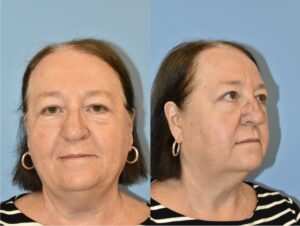
According to Dr. Yver, Kathy’s case was particularly challenging because the nasal defect was large and full-thickness, meaning it involved all three layers of the nose – the skin, cartilage, and inner lining. This requires a separate reconstruction for each, often in more than one stage. Another challenging factor was that Kathy needed high-dose adjuvant radiation, ideally within four weeks of the initial surgery.
“This meant that the clock was ticking, and we only had time for a two-stage reconstructive plan, not three stages,” Dr. Yver said. “Also, radiation is very hard on the reconstructed tissue. We had to give her a robust, viable reconstruction, or there was a risk the reconstructed tissue could shrivel up and die during the radiation.”
When Kathy met with Dr. Yver to discuss the reconstruction process, Kathy said, “I was impressed by her compassion and thorough explanations.”
Surgery and Reconstruction
The outpatient surgery to remove the mass was a textbook, one-hour procedure. Kathy had little to no pain afterward. The first reconstruction surgery, however, was four hours.
As Dr. Yver explained, they agreed on a plan that involved reconstructing the external nasal skin with skin from Kathy’s forehead, (a paramedian forehead flap), the support from ear cartilage, and the inner lining with skin from her cheek (a nasolabial flap). It was a staged procedure, so she had a longer initial surgery and then a secondary surgery to divide the pedicles from her forehead flap and nasolabial flap three weeks later. After that, she went straight to radiation. A minor touch up procedure was performed six months later.
“These cases are challenging because there is so much at play,” Dr. Yver said. They involve the oncologic outcome (i.e. treating the cancer), planning a multistage reconstruction of all involved layers, finishing the reconstruction in time for radiation, and giving [the patient] an acceptable cosmetic outcome while also trying to preserve their nasal breathing. The latter is difficult when they are radiated to that area and not always possible, added Dr. Yver.
Now finished with treatment, Kathy continues to have follow-up appointments to monitor any changes in her health. “I have been so impressed with the care, expertise, and compassion of all the teams that participated in my care from the initial visit to my ongoing follow-ups,” she said.
To learn more about Dr. Yver, go to her Pitt page here or follow her on Instagram