Commitment to community is inherent to the mission of CORAP (Community Ophthalmology & Remote Access Programs), Program Manager Zeila Hobson said in the Eye & Ear Foundation’s August 26th webinar, “CORAP: Eye Care at the Right Time, in the Right Place.” Evan L. Waxman, MD, PhD, Founder and Director of Eyes on Wheels (formerly Guerrilla Eye Service) and Division Chief, Comprehensive Eye Service, also presented.
CORAP is embedded at the UPMC Vision Institute, led by Dr. Waxman, and backed by the EEF Advancing Care Together Sponsorship program as part of the Access to Care initiative. The team includes two medical doctors that support outreach, insurance navigation and research. A technician supports all events, and a project specialist supports the Diabetic Retinopathy Screening Program.
“Patient care, research, education, and innovation are all at the forefront of our minds here at the University of Pittsburgh and UPMC, but none of those are possible without an inclusive approach and dedication to delivering care exactly where it is needed,” Hobson said. “Our goal is to eliminate barriers to vision care for as many Pittsburgh populations as possible, especially seniors, whose independence and quality of life is so important, by reducing transportation barriers, financial barriers and more.”
CORAP has built a wide ecosystem of interconnected initiatives that provide comprehensive vision services to thousands of patients in the Pittsburgh region. These include its mobile clinic models, embedding screening devices in primary care offices, helping patients navigate insurance and financial assistance, hosting large-scale clinic events, gathering metrics from these programs to submit research projects for publication.
How It All Began
After medical students showed up once a year at Dr. Waxman’s office asking to form a local chapter of Sight Savers or a similar event, they held an eyeglass drive. He never heard from them again until the following year when another group of med students came by with the same request. There was no institutional memory of anyone doing anything.
At the same time, the Department was regularly sending its residents to Honduras to do mission work in ophthalmology and getting regular requests to show up at health fairs. It finally occurred to them that they needed to combine these ideas, get out into the community, make use of med student energies, and essentially do missions in its own backyard.
Since 2006, med students and portable equipment go out to where patients in and around Pittsburgh receive primary care – averaging about three missions a month. “This delivery without charge for front to back eye care is equivalent to what you’d get in your own doctor’s office,” Dr. Waxman said. It has been the launching point for all the programs under CORAP.
Mobile Eye Care
Mobile clinic initiatives include several models.
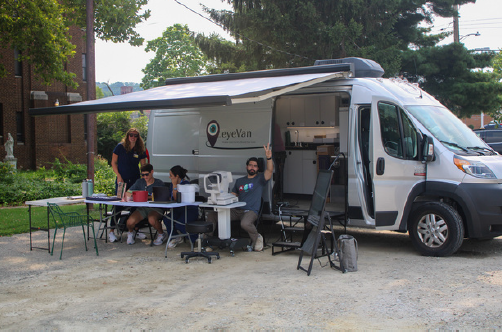
The eyeVan is a fully built-out exam room donated by the Brother’s Brother Foundation that is used often. Optional, additional exam lanes are set up next to the eyeVan in the parking lot, park, or adjacent outdoor community space (though these are sub-optimal exam conditions). The eyeVan allows for facilitation of outdoor exams on underserved populations without the need for a secondary space. The eyeVan mostly targets optometry events for younger and unhoused populations.
The most common model is the indoor pop-up clinic with a cargo van called eyeTruck, or Eyes on Wheels. This is a medical student-driven program that visits federally qualified health centers at nights and weekends. These events are staffed by volunteer providers from both in and outside of UPMC. They expanded access to the newly created Duquesne Med School.
The eyeTruck is also used for daytime clinics facilitated by CORAP core staff (solely UPMC employees) in nontraditional clinic spaces like assisted living facilities. The majority of the mobile clinics are these daytime events 2-3x per week, while the student-led events occur 1-2x per month.
The Chief Resident of the Comprehensive Eye Service (CES) comes out with the eyeTruck for the daytime clinic every week, sometimes 2x per week, to act as the provider as an informal addition to the Ophthalmology Residency curriculum.
The eyeTruck has increased accessibility for patients with mobility issues. Exams are facilitated in community space that can accommodate exam lanes (15-20 feet). It allows for optimal exam conditions, due to the ability to control temperature, lighting, patient privacy, and use a higher bandwidth wireless connection.
Mobile Vision Clinics: New Approaches & Partnerships
A great way to emphasize how much the mobile clinic initiatives have grown since 2024 is to visually represent the partners.
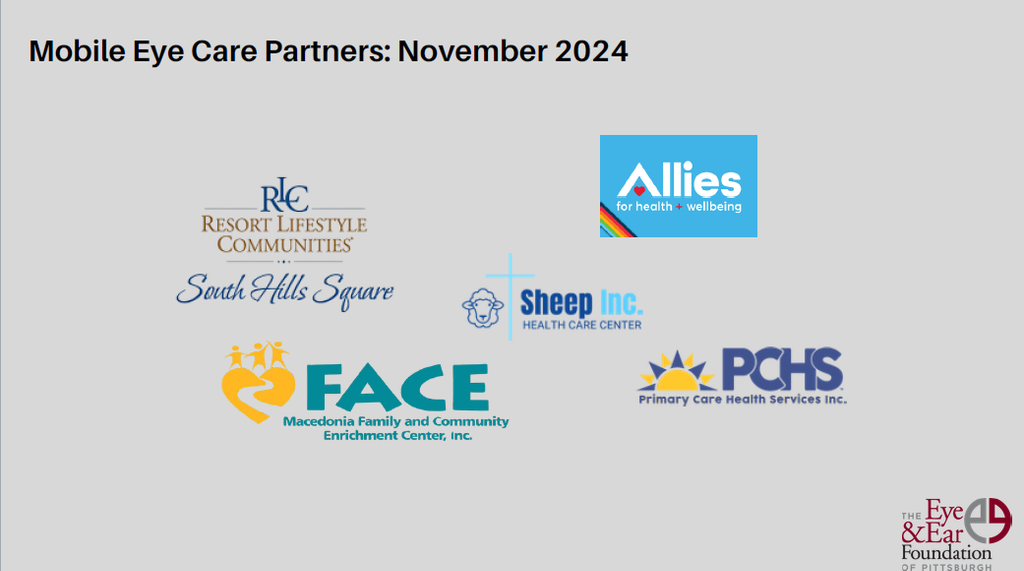
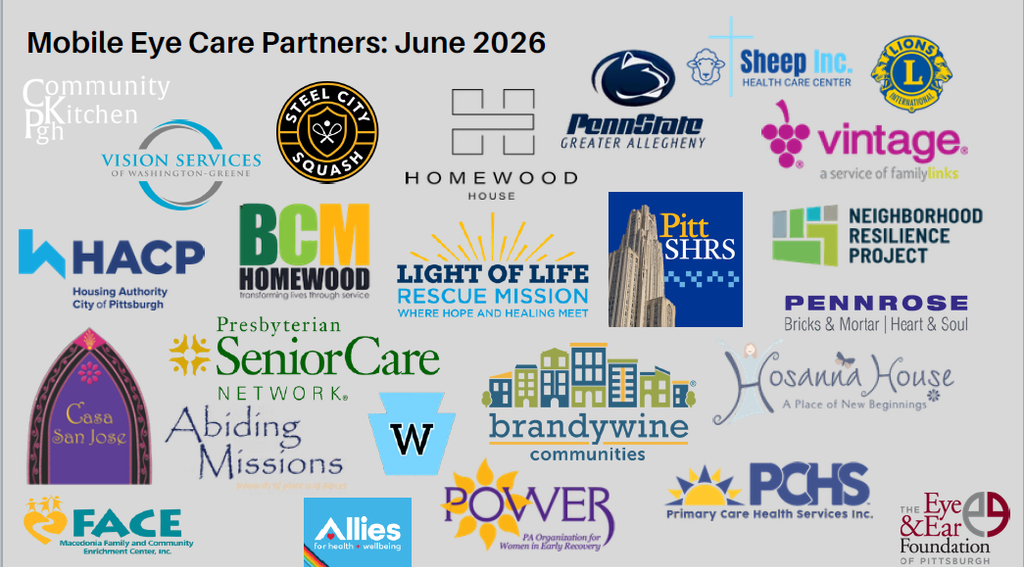
As of this summer, the clinic programs have grown exponentially. “Now we have the wonderful problem of needing to refine our partnerships in 2027 in order to keep scaling,” Hobson said. “We have over 40 active community partner locations across four counties in the Pittsburgh region.”
This year, CORAP experimented with different care delivery models and educational programming to inform its approach in 2027. They started piloting tele-optometry mobile clinic events in the eyeVan through a partnership with the Pittsburgh Street Medicine team with Dr. Anna White and Dr. Robert Bittner. Monthly or quarterly, they visit Community Kitchens Pittsburgh, Carnegie Library – E. Liberty, and Pennsylvania Organization for Women in Early Recovery (POWER).
In May 2026, Dr. Anna Gushchin did an educational workshop at Montessori Academy.
CORAP is especially grateful to support special needs populations several times a year. In collaboration with UPMC, Duquesne Med, and PittMed, CORAP screened more than 60 athletes at the Special Olympics in April. They also absorbed the bi-annual pop-up clinics at the Verland Foundation previously managed by the UPMC Ophthalmology Department.
Mobile Clinic Patient Metrics, Follow-Ups, and Referrals
At the mobile clinics alone, CORAP’s programs have served over 1,000 patients and provided nearly 1,000 pairs of free eyeglasses via Changing Life Through Lenses.
“I’ve spouted plenty of metrics and want to recognize that each data point represents a community member in need of accessible vision care,” Hobson said. She shared two patient stories. One was a Patient J, a 79-year-old insured man who was seen by the eyeVan at Homewood Community Engagement Center in February 2025. He presented with symptoms of cataracts and glaucoma, both of which were confirmed during follow-up visits at the VI. He underwent successful cataract surgery in both eyes, reports improved vision, and is now being monitored for glaucoma.
Dr. White, UPitt Street Medicine Clinical Director, heard from a gentleman who was seen by the eyeVan at the Carnegie Library in E. Liberty in February 2026. One of his passions is the saxophone. He was so excited to hear that he might be able to get glasses as he’d “be able to see the sheet music again.”
Patient J and Dr. White’s unhoused patient are the tip of the iceberg, Hobson added. “We have met an insured patient in Hazelwood fully blind from cataracts (unheard of in a first-world country). We have navigated insurance processes for a reluctant patient in desperate need of uveitis intervention (among many others), worked to build trust with populations heavily affected by ICE, and approached every patient with compassion and dignity.
At the mobile clinics, referrals are scheduled for those who need follow-up care, like Patient J. Many have expected surgical outcomes, especially cataract removals.
Mobile clinics aren’t CORAP’s only means of care delivery. The team also led the Vision Section of the Mission of Mercy health clinic in 2024 and 2025, offering vision screenings alongside the dental and hearing screenings available. Those massive clinics only spanned four days total yet yielded over a thousand exams and glasses orders. These two clinics had 150+ volunteers, 1,220 glasses ordered, and 141 specialist referrals.
UPMC Community Vision Day (CVD), is a quarterly model for large-scale community eye care offering no-cost services to all patients. CVD is Dr. Sahel’s brainchild and the largest free clinic initiative ever attempted in the UPMC ecosystem. It improved care delivery for populations served at Mission of Mercy events and became a pathway for uninsured patients to receive specialist follow-up care and initiate insurance applications to cover their continued care.
CVD aims to reach underserved populations all year round in an environment that sets both the patients and clinical staff up for success. This year, patients will be registered for eye exams at Mission of Mercy on October 16-17, and then those exams will occur at CVD on October 18 at the Vision Institute.
So far there have been four CVD events, with the most recent this past weekend. Over 450 unique patients have been served; they are predominantly uninsured and non-English speaking. Every event is better than the last, with improvements made to clinic workflows based on patient and volunteer feedback.
“Because we can route follow-ups for uninsured patients to Community Vision Day, referral outcomes for our programs are much higher than the institutional average,” Hobson said. “We are learning that the first point of care is important, but the second and third are crucial to ensuring continued care for our neighbors in need.”
Diabetic Retinopathy Screening Program
Another dimension of CORAP’s programs is embedding ophthalmic devices into primary care environments. Over 40 of these cameras are deployed across PA and recently expanded into western MD. Launched in 2016, the program includes primary care and endocrinology offices internal and external to UPMC, with 24 to 48-hour image interpretation and follow-up recommendations. Staff training and camera troubleshooting is supported by CORAP.
Dr. Waxman emphasized that diabetes is the leading cause of vision loss in working age Americans. The recommendation is that everyone who has diabetes get an eye exam every year, but fewer than 50% of folks who should do. In and around Pittsburgh, that statistic is worse. “As a result, people lose vision from diabetic retinopathy because we’re not taking care of them soon enough,” he said. Many consultations for diabetic retinopathy rule out the condition, he added. It is just as important to take the burden off folks who are managing diabetes and all its complications.
The Eye & Ear Foundation is helping expand this program. Two cameras were recently placed in Armstrong County. CORAP is working on projects to improve image quality and increase engagement at partner locations.
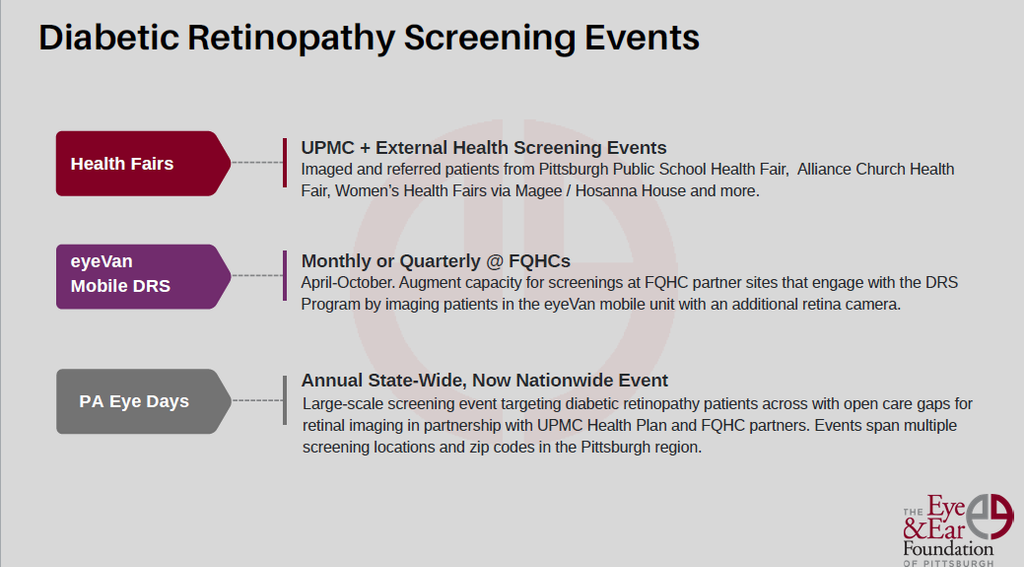
CORAP helps facilitate device trials related to diabetic retinopathy screening, such as the Phelcom Eyer2 and Optain Resolve, the latter of which is about to start Phase 2. These projects are done in collaboration with UPMC Enterprise and UPMC Health Technology Advancement Program (HTAP).
CORAP is also a research lab, focused on sharing findings in medical and public health journals. Several papers have already been successfully published. A few more have been submitted. Abstracts were recently accepted at the American Public Health Association Conference this fall.
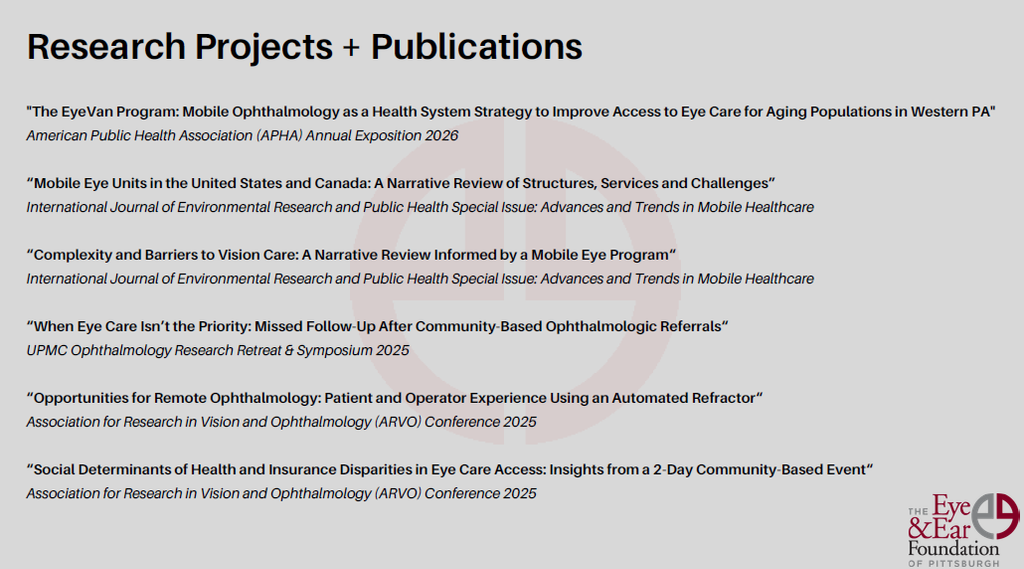
Research projects are often student-driven, with medical student researchers garnering awards for their projects under CORAP mentorship.
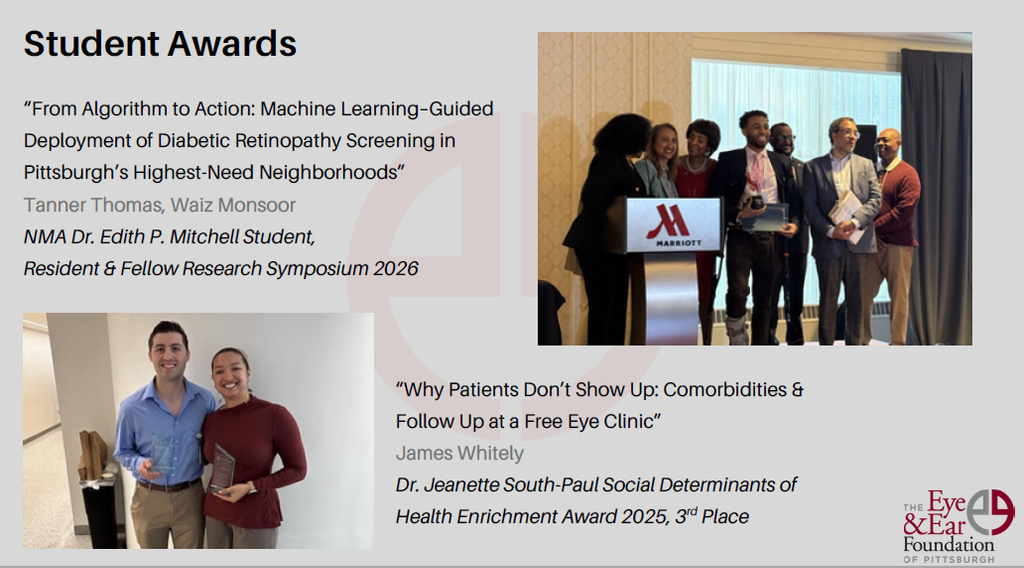
Dr. Waxman said it is important to recognize that CORAP is a training ground for physicians who recognize that delivery of care is what drives them; this is an important facet of patient care and research. Infrastructure now exists, along with integrations with the Department of Ophthalmology that allows for additional training. The chief resident comes out with the eyeVan almost weekly to precept the med students. The med students are engaged in CVDs, not just as support staff, but as technical staff, imaging patients and facilitating workups. “So, both med students and residents are getting hands-on training in high impact, high pressure clinic environments,” Hobson said.
CORAP Milestones
CORAP is always working on the next big thing. In Q3, CORAP continued the Street Medicine partnership, submitted additional research papers, hosted another successful Community Vision Day, and launched a device trial for a handheld retina camera at Mercy Pavilion.
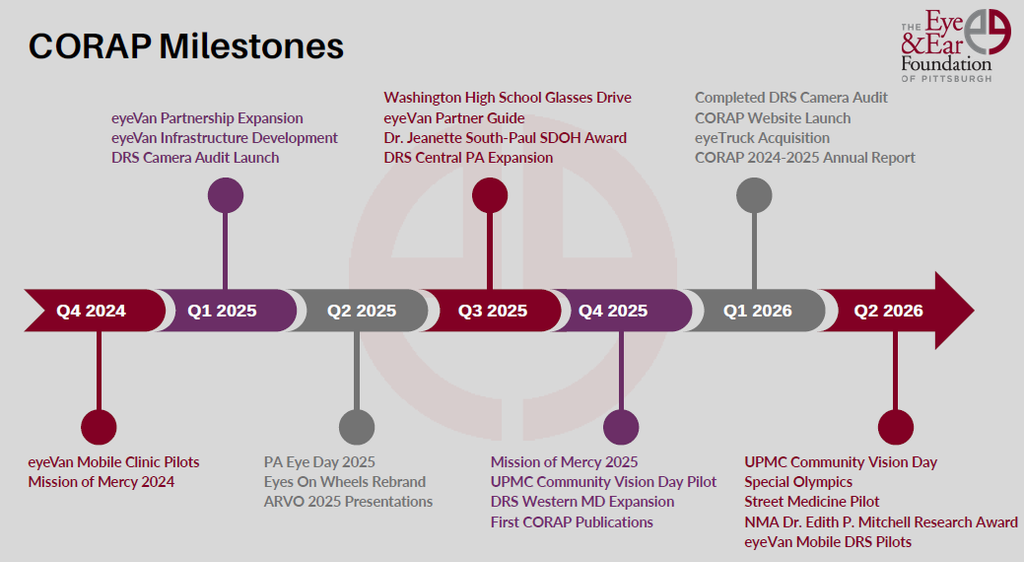
In less than two years, CORAP has reached more than 3,000 patients, ordered 2,931 eyeglasses through Changing Life Through Lenses, and scheduled more than 1,407 referrals. The majority of those patients are seeing better with their free pair of eyeglasses, and nearly half were scheduled for referrals that were largely fulfilled.
Looking Ahead: Primary Care Ophthalmology Suites
The plan is to embed ophthalmic devices for ophthalmology tele-health in primary care setting(s) by the end of the year. Device trials are ongoing to determine best approaches to eye services in inpatient and emergency department settings. CORAP has begun building an ophthalmology suite at the Alma Illery Health Center in Homewood, dubbed Project Ophanim, and expects to pilot eye exams there this fall. CORAP is seeking additional funding to support pilots at eager partner locations like UPMC Mathilda Theiss.
The Project Ophanim initiative will also be embedded in the UPMC Ophthalmic Technician training program curriculum to staff the remote ophthalmology clinic(s) and provide the aspiring techs with hands-on experience in the field.
Looking ahead, the goal with mobile clinics is to refine tele-optometry workflows, develop billing protocol for mobile vision clinics, and offer pediatric services. Large-scale clinics include the Washington High School Glasses Drive, UPMC CVD, and PA Eye Day 2027 with UPMC Health Plan. In terms of remote access, the goal is to integrate ophthalmic devices into emergency departments and primary care and continue diabetic retinopathy program optimization and expansion.
“I want to thank from the bottom of my heart our sponsors, students, staff, and volunteers,” Hobson said. “We can’t do this, we can’t facilitate these programs without the free time of our admin, med students, and providers who are dedicated to meeting patients where they are and helping our patients in need.” Hobson and Dr. Waxman also thanked program sponsors.
“We are deeply grateful for those of you who have given to the cause,” Dr. Waxman added. “In addition to direct patient care, we are going to be able to share best models for delivery of care to everybody else in the country and maybe beyond.”