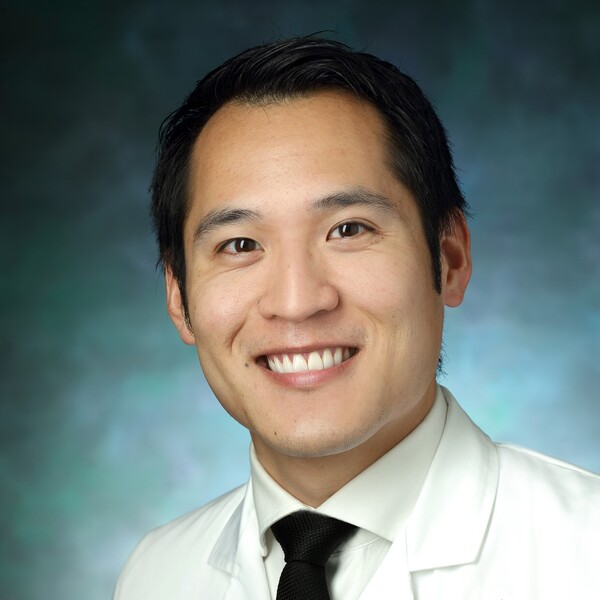
The newest Assistant Professor of Otolaryngology-Head & Neck Surgery, George Liu, MD, was drawn to Pittsburgh mostly for two things: the Department and the city itself.
Dr. Liu praised the Department’s depth in both clinical care and hearing science. “Between the Pittsburgh Hearing Research Center and the mentors I’ll have here, it’s a rare combination,” he said.
He also described the city as “one of the few places where I can walk down the street and collaborate with world-class AI researchers in the Department of Biomedical Informatics at the University of Pittsburgh as well as at Carnegie Mellon. My work sits at that intersection, and there aren’t many cities where both halves are this strong. The Eye & Ear Foundation’s support and leadership of the Department were real factors too.”
The neurotologist and surgeon-scientist joined the University of Pittsburgh from the Johns Hopkins University School of Medicine, where he completed fellowship training in neurotology and skull base surgery. He completed his residency in otolaryngology-head and neck surgery and earned his medical degree at Stanford University and holds an undergraduate degree in physics from Princeton University.
As a neurotologist, Dr. Liu cares for patients with hearing loss and balance disorders, including cochlear implants, middle ear surgery, and skull base surgeries, including those for vestibular disorders such as superior canal dehiscence syndrome and tumors affecting the vestibular nerve.
“Dr. Liu is a rising leader in neurotology,” said Peter Santa Maria, MD, PhD, Professor, Division Chief of Otology & Neurotology. “His research sits at the intersection of artificial intelligence and hearing and balance disorders, and it promises to deliver new treatment paradigms for our patients.”
Many of Dr. Liu’s patients with vestibular disorders, or ear-related dizziness, have spent months, sometimes years, being passed between emergency rooms and specialists before getting a clear diagnosis and treatment plan that works for them.
Vestibular disorders are hard to diagnose, Dr. Liu said, and the expertise to do it well is concentrated in a handful of centers. Dr. Liu wants to build and rigorously test AI tools that can help make that diagnosis faster and more accurate and ultimately improve access to and quality of care for dizziness.
He led the first scoping review of deep learning across otolaryngology (npj Digital Medicine, 2025), which defined the “AI chasm” in the specialty, the gap between abundant proof-of-concept studies and the few tools validated in clinical care.
“My goal is to run the studies needed to take these tools all the way to clinical trials, so they can eventually reach patients outside academic medical centers,” Dr. Liu said. “I’ve already connected with faculty across Pitt and CMU who are excited to collaborate.”
Having grown up in Western New York, not far from Pittsburgh, Dr. Liu was always curious about the Steel City. The first Super Bowl he ever watched was the Steelers beating the Cardinals in 2009. “I’m looking forward to being part of the sports, technology, and cultural legacy here,” he said.