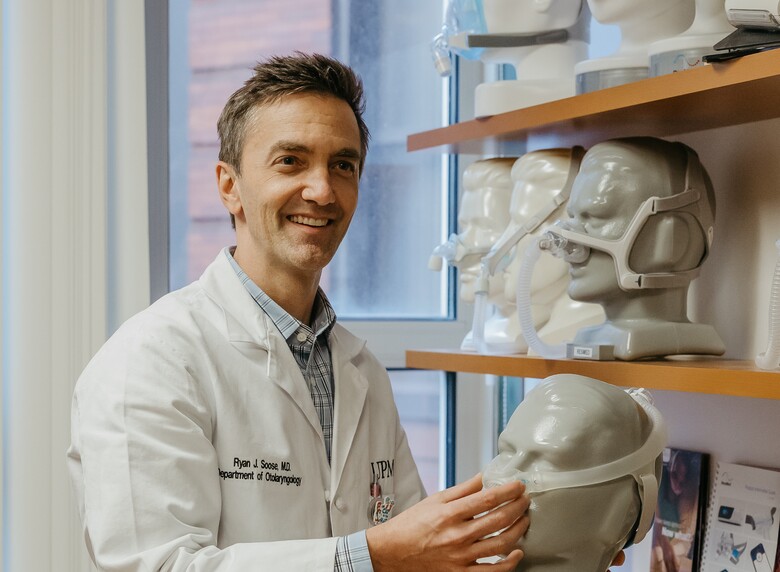
Ryan Soose, MD, Chief of the UPMC Sleep Division, was appreciative of the opportunity to speak about and share some of the exciting things happening with sleep apnea in the Eye & Ear Foundation’s August 10th webinar, “Soft Palate Surgery for Sleep Apnea: Four Decades of UPPP Data and New Directions.” He called it a space that is always evolving and changing for the better, with Pitt a leader in many ways.
UPMC Sleep Division
Dr. Soose extolled the wonderful legacy in Pittsburgh, where some of the most brilliant world leaders in sleep are from. The city has really left an impact on the field, from Dr. Mark Sanders and Pat Strollo’s Respironics to the BiPAP machine, which was invented here in the 80s. Former Department Chair Dr. Jonas Johnson was a leader in sleep surgery for decades and one of Dr. Soose’s key mentors. “Without his vision, support, and guidance, honestly I wouldn’t be here, and our Sleep Division probably wouldn’t be here,” Dr. Soose said.
A doctor at Western Psych has an entire team dedicated to insomnia research, one of the thought leaders in the entire world. Dr. Rogers, a dentist from Pittsburgh, pioneered dental devices for sleep apnea and even founded the American Academy of Sleep Medicine out of his Pittsburgh home.
“This is not new,” Dr. Soose said. “The team that you see here is standing on the shoulders of all these giants and pioneers. I have to thank Dr. Zevallos, our current chair, for really backing and supporting this team as it continues to grow and evolve.”
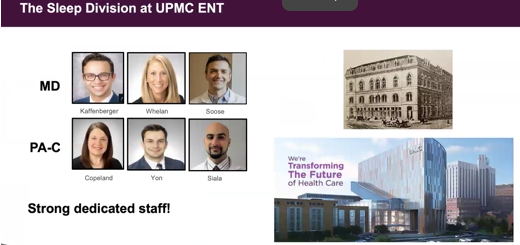
The Sleep Division has three physicians who are dual boarded and trained in sleep medicine and otolaryngology. In addition to Dr. Soose, there is Dr. Kaffenberger, who splits his time between the University, Mercy, and Monroeville, as well as the VA. Dr. Whalen splits her time between Children’s and Mercy and is one of the country’s experts in pediatric sleep apnea and sleep surgery.
Three “wonderfully talented expert” physician assistants are also part of the Sleep Division and are now taking their expertise more to the communities. A lot of the Division’s success is due to an “extremely dedicated and talented” staff of MAs, nurses, sleep techs, and research coordinators “that really allow us to do what we do every day,” Dr. Soose said.
The Division is proudly based out of Mercy, the oldest hospital in Pittsburgh (founded in 1847).
Another thing Dr. Soose is proud of is that the Division has had more residents and fellows become sleep surgeons, key opinion leaders, and division chiefs at many other big centers around the country. “It’s a growing crew of people compared to many institutions that might have one or two trainees at the most that have gotten to this level” he said. “We’re now in double digits in Pittsburgh. This has really allowed us to take this Pitt legacy and spread it all over the country and even internationally.” A lot of these folks continue to collaborate on research in multicenter studies.
The ‘Sleep ENT’ at the Helm
This team is needed because sleep apnea is an extremely common condition, affecting tens of millions of people in the US alone. Worldwide, the latest studies show it affects about a billion people. In the US, there are more people with sleep apnea than hearing loss, and this is not even counting pediatric sleep apnea, sleep apnea in the elderly, or even people who snore without sleep apnea. The total numbers are even more staggering.
The team’s goals are to help patients achieve better sleep, health, and quality of life. Each of these have multiple arms; for quality of life, this includes waking up to go to the bathroom, morning headaches, brain fog, daytime sleepiness, work productivity, marriage and relationships, etc.
There is a big impact on brain health, like dementia and cardiovascular health, like atrial fibrillation, hypertension, and heart disease. People with untreated moderate to severe sleep apnea have been shown to have more heart attacks and strokes the longer the condition is left untreated.
When Dr. Soose trained, there were two main courses of treatment: a fixed pressure, uncomfortable CPAP machine that involves a big fighter pilot mask, or rudimentary surgery that involves cutting out some tissue in the back of the throat. Now there is a growing, fun toolbox of things that can be combined, a team that boarded and trained, and medical and surgical experts. This means the whole gamut of other sleep disorders can be covered, the Division can read and interpret their own sleep studies, order and troubleshoot the latest smallest versions of CPAP, order, assess, and troubleshoot custom mouthpieces or dental devices.
The toolbox includes hypoglossal nerve stimulation (HGNS, which Pittsburgh helped pioneer), sleep diagnosis, sleep study, CPAP, dental, weight loss, medications, nasal surgery, palate surgery, and skeletal surgery. Weight loss is key now. Eighteen months ago, the FDA approved Zepbound for sleep apnea. There is also a pill that has been approved that will be released later this year. The team served as study chairs for big multicenter studies that helped lead to FDA approval.
“We still need more,” Dr. Soose said. “A lot of people aren’t candidates for surgery or can’t do some of the medical devices. We need to find new solutions.”
Dr. Soose said the Eye & Ear Foundation has been key to that. A recent donor provided a very generous donation that will help the team to really innovate and develop some of these new treatments that will ultimately allow them to continue to expand the toolbox.
Traditional UPPP
Twenty-two years ago, one of Dr. Soose’s mentors, Dr. Weaver, did a powerful study which found that uvulopalatopharyngoplasty (UPPP) improved survival. CPAP had been thought to be more effective. The results supported the notion that a partial disease reduction with surgery might be at least as effective as a medical device that struggles with compliance use.
Over the last two decades, particularly from 2004 to 2014-2020ish, the rate of that UP surgery dropped precipitously. Why?
Traditional UPPP dates back to 1981 when Dr. Fujita in Japan invented the surgery. Fifteen years later, Dr. Sher put together the first meta-analysis: 37 papers that covered about 500 patients, defined success as a 50% drop in apnea scores, with a final score of less than 20 events an hour. That definition – for better or worse – has stuck to this day.
This surgery involves removing the tonsils, uvula, portions of the soft palate lining and muscles. Scarring often creates other types of issues. However, the success rate is only 41%. “I don’t know how many of you would sign up for a surgery that was rather painful, with time off work and potential complications, for less than a flip of the coin whether it was going to achieve the goals,” Dr. Soose said.
In 2010, 15 years later, there was another meta-analysis, but the results were a little bit worse. Authors published results of a jaw surgery – breaking and moving the upper and lower jaws to open the airway – that put the UPP surgery in a negative light. At this time is when the first nerve stimulator implant began its Phase 3 pivotal trial and on the rise. It is also when the American Academy of Dental Sleep Medicine got going and was publishing data on the effectiveness of custom mouthpieces that bring the jaw forward. In some ways, this was the perfect storm.
That year, the American Academy of Sleep Medicine (AASM) published its Practice Parameters, stating that, “UPPP as a sole procedure, with or without tonsillectomy, does not reliably normalize the AHI when treating moderate to severe obstructive sleep apnea syndrome.” It also stated “…there is a lack of rigorous data evaluating surgical modifications of the upper airway.”
Is there still a role for traditional UPPP? In less than a decade, it went from being potentially life saving to rarely performed and not even recommended.
Tonsillectomy
Does tonsillectomy alone have better outcomes? A systematic review and meta-analysis of a tonsillectomy without UPPP looked at 17 studies with tonsil grade 2, 3, and 4. There was a 65% reduction in in apnea scores.
Instead of looking at historical data and other studies, in a randomized study, Swedish researchers looked at 45 patients with sleep apnea, similar BMI and baseline characteristics. In 45 patients who just got their tonsils out, and 45 patients who got their tonsils out with a palate procedure, researchers looked at the degree of apnea score reduction. Patients with just their tonsils removed had better results.
The durability of UPPP results was also investigated. Sleep apnea is a chronic lifelong condition that has to be managed across the lifespan, like diabetes or asthma. Is it still treated at a year? Two years? Ten years?
The Swedish group tracked those same patients. At six months, the results were good. They were unchanged at two years. At eight years, there was some relapse, but could that be due to aging effects or weight change? The results suggest that people need to be monitored long-term and that maybe surgery results do not last forever.
Side Effects
In a review of 24 studies, there are some side effects from traditional UPPPs that are common, underreported, and potentially bothersome and irreversible.
- Globus sensation (31.2%) – feeling like there is a lump or something in the back of the throat
- Dry throat (23.4%)
- Dysphagia (17.7%)
- Voice change (9.5%)
- Taste loss (8.2%)
- VPI (8.1%)
The procedure is not totally benign, and benefits must be cautiously weighed against these side effects.
Why do these side effects occur, however? Dr. Soose thinks one key may lie in the uvula. One of the uvula’s many functions is the base holds the largest concentration of thin, watery saliva glands in the mouth and throat. Studies using a video stroboscopy slows this down, showing that when people swallow, the uvula contracts, large vacuoles of that thin saliva run down, and the uvula almost acts as a basting brush to splash the back of the throat with the watery saliva. When that is cut off, the lubricating function is lost.
Palate Surgery
Is there still hope for palate surgery? Dr. Soose admitted he painted a pretty grim picture so far, but there really is a strong future. The surgery is rebounding due to a paradigm shift in technique, using a reconstructive approach rather than excisional.
Sleep apnea physiology research has shown that the issue is not excess tissue that needs to be removed. Rather, it is a problem of collapsibility. The throat is a soft, muscular collapsible tube that results in snoring and sleep apnea. Instead of removing tissue, the throat needs to be enlarged and stabilized. This is why some of the other treatments (CPAP, nerve stimulation) work quite well.
From about 2007-2024, multiple surgeons around the world developed reconstructive modifications. Rather than trying to remove tissue, these surgeries all have the same goal of trying to get to the underlying muscles of the throat to reposition and suspend. In other words, enlarging and stabilizing the airway with suspension techniques.
Dr. Woodson took cleft palate surgery aimed to close the throat and reversed it about 15-17 years ago. Dr. Soose worked directly with him in his OR. The procedure, expansion sphincter pharyngoplasty, took the muscle out of its attachments on the side of the throat, rotated it as a muscle flap, and pulled it anteriorly, superiorly, and laterally, to suspend and enlarge that portion of the throat. “Think of it as a facelift for the throat,” Dr Soose said.
One of the greatest compliments Dr. Soose ever got was when one of his patients who had this surgery moved to California and saw a sleep medicine physician there. The patient told the doctor he had this surgery in Pittsburgh, but the doctor did not believe him. “To me, the greatest compliment is that I enlarged his airway without altering, excising, or distorting his anatomy,” Dr. Soose said. He has a more “normal” throat with symmetry, and better width and depth.
This technique is personalized to anatomy, endoscopy, and imaging. In an effort to let sleep physicians around the country know that palate surgery is not dead but is only growing and evolving with lots of favorable data, Dr. Kaffenberger partnered with Dr. Soose, Dr. Woodson, and other key thought leaders to put together a massive review and messaging published last year in the Journal of Clinical Sleep Medicine.
Personalized Reconstructive Techniques
The latest data has confirmed that this technique improves effectiveness. In a randomized study by Dr. Woodson, there was 78% reduction with the new procedure, and 45% with the old. A 15-year review of modified UPPP in different centers found that the mean apnea score reduction was much more favorable than previously. If the same criteria in the old meta-analyses are used, the new rate is 80% instead of 41%. “I think more of you would sign up for a surgery that has an 80% chance of helping rather than 41%,” Dr. Soose said.
Though it has yet to be proven, clinical experience and some early data suggests that the voice, swallowing, and taste complications are being reduced with this procedure. It may also reduce cardiovascular risk. The Swedish researchers found that there was a 60% reduction in apnea scores after surgery, with gets the sleep apnea out of severe range. As a result, blood pressure improved. In fact, the blood pressure drop is huge and is shown to correlate with a lower risk of stroke and heart attack.
More evidence that mUPPP may reduce cardiovascular risk comes from Korea, which has a national database. Due to its massive numbers, the data is more compelling. They showed that patients who had surgery had a lower incidence of cardiovascular complications when compared to no surgery at all.
Summary and Look Ahead
- Limited role for traditional excisional UPPP – even though unfortunately many community surgeons still doing this at most academic medical centers
- Tonsillectomy alone may be as effective (if not more)
- New reconstructive modifications have better outcomes and less morbidity than excisional UPPP
- Modified UPPP reduces health risk especially compared to no treatment at all
What is the role of palate surgery in this new era? “As a Sleep Division, our job is to determine this, especially now that we have new nerve stimulation implants approved,” Dr. Soose said. A third was just approved this year, and there are another 10 companies in development and in clinical trials.
Looking at how palate surgery fits in with GLP-1 medications and new treatments to selectively target and shrink fat in the tongue is also important. What is the role with new medications coming onto the market? “It’s not one or the other,” Dr. Soose said. “All of these are complementary, and in many of our patients, the people that get the best results are the ones that have multi-modality therapy. We need to provide the roadmap for otolaryngologists around the country and the world as to how that should be done thoughtfully in each individual patient.”