The topic of the Eye & Ear Foundation’s September 11 webinar, “Hearing Loss: Unexplained Causes and Immune-Mediated Conditions,” is starting to gain attention, said presenter Peter Santa Maria, MD, PhD, Professor and Division Chief of Otology & Neurotology and Vice Chair of Translational and Clinical Research in the Department of Otolaryngology-Head & Neck Surgery.
When referring to unexplained causes and immune-mediated conditions of hearing loss, the medical terminology used is “idiopathic.” Dr. Santa Maria expressed his frustration with this word, as he thinks there is always a cause – it just has not been found yet. “That’s what we’re trying to do here,” he said. “We’re trying to unlock the immune system in hearing.”
Ear Anatomy 101
The ear has three connected sections. Sound enters the outer ear (ear canal and eardrum), crosses the middle ear (tiny bones called ossicles that amplify vibration), and is turned into nerve signals in the inner ear (cochlea, converts vibration to nerve signals).
Conductive hearing loss covers the outer and middle ear. Sensorineural hearing loss is bundling together the cochlea (sensory) and nerve (neural), as it can be hard to tell the difference.
How We Hear and How It Usually Fails
The ear canal channels sound to the eardrum, causing the eardrum to vibrate. The vibration passes to three tiny bones, which boost the signal into the inner ear. Cochlear hair cells turn this vibration into nerve signals, which are carried to the brain, where it interprets the sound. Damage anywhere along this path causes hearing loss. The usual suspects are noise exposure, aging, genetics, infection, and trauma. These usually show a clear, steady, explainable pattern.
Ears age, like the rest of our body. This commonly looks like high frequency hearing loss, as the high frequencies tend to go before the low ones. Some age faster than others. There are some genetic causes, but Dr. Santa Maria believes the immune system can play a role in aging the ear faster or slower.
Noise exposure is a big cause of hearing loss. We live in a very noisy world with many common exposures. But why do some people go through their life recreational hunting and have great hearing while others can hear one gunshot at a gun range and have a significant drop in hearing? The immune system can play roles in this difference.
A lot of Dr. Santa Maria’s lab looks at chronic separative otitis media, or chronic ear infections – the number one cause of hearing loss in children in the developing world. The lab has found that the immune system is reactive in those infections. It is not the bacteria itself causing damage, but the immune response to those bacteria causing the damage.
When There Is No Obvious Cause
Many patients come in with hearing loss – sometimes with dizziness – that does not fit the usual patterns. The hearing loss may come and go, affect both ears, or show up suddenly with no history of noise or infections. For a growing number of these patients, the explanation is not in the ear at all, but the immune system.
About 5-20 per 100,000 people a year develop sudden sensorineural hearing loss, a share of which turns out to be immune-related. Dr. Santa Maria’s record is seeing nine people in one day with this problem. There are a couple of possible causes, like an inner ear heart attack or a virus, but no way to prove either. The ear cannot be biopsied because that would destroy it.
Meet Your Immune System’s Security Team
Your immune system is like a security team patrolling your body, finding and neutralizing germs, damaged cells, and toxins before they cause harm. The normal response is when the team responds to a real thread – infection, injury, noise – then stands down once it is handled. An overactive response is when the team overreacts or will not stand down, causing ongoing collateral damage in the ear. A misdirected response is when the team loses track of ‘friend vs. foe’ and mistakenly targets the body’s own inner ear tissue.
Immune-mediated hearing loss comes from the second and third scenarios. It is not a failure of the ear itself, but a misfiring security team.
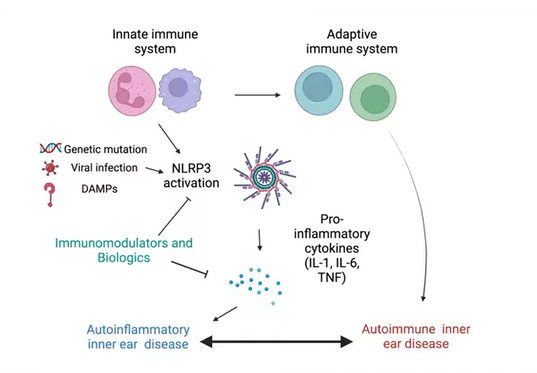
An innate immune system is kind of like a first responder – it involves nonspecific cells, comes in and reacts to things, cleans up, or attacks. An adaptive immune system is specific, targeting specific things to attack them.
An innate immune system produces more of an inflammatory reaction, releasing chemical signals in response to viruses or bacteria. If it is overactive or forgets to switch off, this is called an autoinflammatory inner ear disease. If adaptive is overactive, it is an autoimmune inner ear disease.
The Immune Spectrum
Immune disease isn’t one thing. It ranges from autoinflammatory (an overactive alarm system) to autoimmune (mistaken identity) and from affecting one organ to affecting the whole body.
A classic textbook version of autoimmune inner ear disease (AIED) is when the immune system mistakes inner ear tissue for a foreign threat and attacks it. The hallmark pattern involves:
- Hearing loss in both ears, though may start in one
- Comes and goes, or steadily worsens over weeks to months
- Sometimes comes with dizziness or a spinning sensation
- Often improves – at least at first – with steroid treatment
The estimated prevalence is about 15 in 100,000 people, or roughly 45,000 Americans at any given time. It is more common in women. This classic definition is narrow, however, and likely misses many patients who could still benefit from treatment.
Widening the Lens: IMIED
Doctors now use a broader term – immune-mediated inner ear disease (IMIED) – for any hearing or balance problem caused by the patient’s own immune system overreacting, whether or not it is classic autoimmunity. This wider definition matters because it shifts the key question from ‘Can we prove it is autoimmune?’ to a more practical one: ‘Would this person’s hearing improve with immune-calming treatment?’ This means more patients get a chance to respond.
About 15-20 million Americans live with an immune-mediated disease of some kind. The inner ear is likely a far larger – and underrecognized – part of that picture than we currently realize.
There are two patterns: primary, when the immune problem appears limited to the ear, and secondary, when the hearing loss occurs alongside a known systemic condition (e.g. lupus, rheumatoid arthritis, psoriasis, Crohn’s disease).
When should you suspect it? No single test confirms IMIED. Instead, doctors look for a pattern, a cluster of clues, that together raise suspicion:
- Sudden or fluctuating hearing loss (especially if it affects both ears)
- Dizziness or imbalance (along with the hearing changes)
- Other body symptoms (joint pain, skin rashes, fatigue, GI issues, fevers)
- Personal or family history (of autoimmune or autoinflammatory disease)
- Improves with steroids (even temporarily – a strong clue)
- Misdiagnosed before (sometimes labeled Meniere’s disease first)
None of these alone is proof, but if several apply to you, it is worth raising with your doctor.
Getting Answers: How a Real Case Gets Worked Up and Diagnosed
Dr. Santa Maria shared one patient’s path. A 62-year-old man who had fluctuating hearing loss in both ears, past episodes of severe vertigo – now settled – originally called Meniere’s, a history of psoriasis and visible changes in the ear canal, and a father with ulcerative colitis, a brother with psoriatic arthritis, and sister and mother with recurrent vertigo. If this sounds like a confusing picture, that is exactly the point.
Looking at the patient’s hearing tests, the fluctuating hearing was evident. The pattern did not fit typical noise or age-related hearing loss. He had moderate hearing loss that was a little worse in the high frequencies. Visit three after treatment showed that his right ear improved. The patient did well with word recognition.
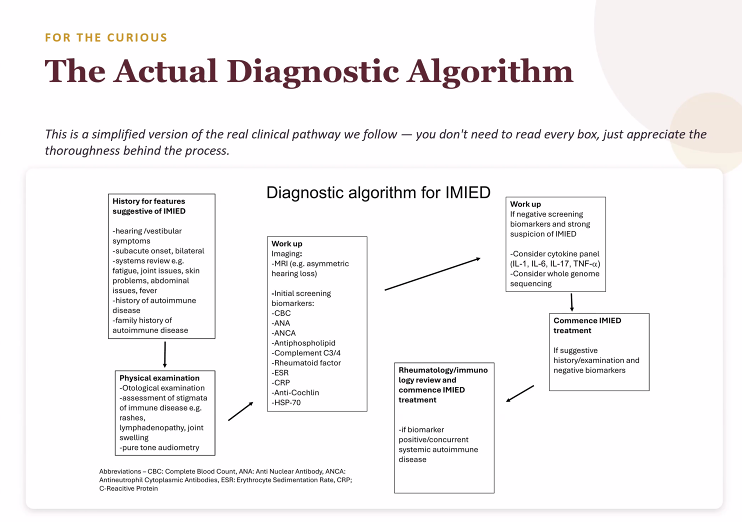
Doctors investigate by:
- History and exam – pattern of hearing loss, other symptoms, family history, ear exam
- Hearing and balance tests -detailed audiogram, and if needed, balance testing
- Blood tests – screen for markers of autoimmune or inflammatory activity
- Imaging, if needed – MRI to rule out other causes, like a tumor
- Trial of treatment – a short steroid course – improvement itself helps confirm the diagnosis
There is no single definitive lab test. Diagnosis relies on the overall pattern and how the ear responds to treatment.
Treatment
The first line is to calm the storm by prescribing corticosteroids (steroids), which broadly quiet an overactive immune response, like turning down the whole security team’s alert level. About 50-70% of patients respond to an initial course. It is either given by mouth – tapering course over several weeks – or by injection directly into the middle ear. This delivers a higher local dose with fewer whole-body effects.
Why not stay on steroids long-term? Extended use carries real risks: mood changes, weight gain, elevated blood sugar, bone thinning, and more. If hearing relapses each time the dose is lowered, it is time to consider a more targeted medicine.
Steroids do not just target one cell type; they dial down activity across many parts of the immune system at once. That breadth is why they work quickly and also why long-term use has broad side effects.
The guidelines for ENTs say for people with sudden hearing loss to try the oral method first and then consider ear injections. This does not make sense to Dr. Santa Maria, however. “If you look at how steroids get into the inner ear, you need to treat both at the same time,” he said. There are exceptions, like people who cannot tolerate oral steroids or blood pressure makes their diabetes unstable, but compromises can be made in those cases.
Dr. Santa Maria will sometimes extend the steroid course if people respond. If they fail to improve, he may taper it earlier.
When Steroids Are Not Enough: Precision Tools
Newer medicines – sometimes called biologics – target one specific messenger chemical in the immune response, rather than quieting the whole system. Think of it as sending one skilled negotiator instead of shutting down all of security.
Targeted immune therapies are used as steroid-sparing options once a patient becomes dependent on or resistant to steroids. They are chosen together with a rheumatology or immunology partner, based on which immune messenger seems to be driving things. To name a few: methotrexate, etanercept, golimumab, and anakinra. Each blocks a different messenger chemical at a different point in the same alarm pathway. Matching the right drug to the right messenger is the goal of precision treatment.
Back to the Patient: The Outcome
The 62-year-old man responded to steroids, confirming an immune cause. Working with rheumatology and dermatology, he was transitioned to a targeted immune therapy. His hearing has stabilized since.
Teamwork
The takeaway? Response to treatment is often the strongest evidence we have that immune activity is behind hearing loss. It takes a team; because the immune system affects the whole body, managing IMIED usually means several specialists working together:
- Otology: diagnoses and monitors the ear, coordinates the plan
- Audiology: tracks hearing over time, guides rehabilitation
- Rheumatology: manages the immune modulating medications
- Dermatology: evaluates related skin findings
- Endocrinology: monitors effects of long-term steroid use
When Hearing Is Already Affected
Even with the best immune treatment, some hearing loss may not fully reverse. That is when hearing rehabilitation comes in.
Hearing aids are the mainstay for milder to moderate loss. They amplify sound to restore day-to-day communication, environmental awareness, and enjoyment of music.
Cochlear implants are an option once hearing aids no longer help enough. About half of patients with immune-related hearing loss develop some scarring or hardening in the cochlea, so imaging beforehand helps plan surgery. Outcomes are generally comparable to the general population.
The Genetics Frontier
Genetic testing can scan dozens of hearing-related genes at once. In one patient with unexplained fluctuating hearing loss, genetic testing found a variant in a gene that was already linked to other autoinflammatory conditions. This pointed directly to a treatment; the patient was started on a targeted anti-inflammatory medication and their hearing stabilized.
More on the Horizon
- Better biomarkers – researchers are searching for a blood test that could reliably flag IMHL and predict treatment response
- New, more targeted drugs – a wave of precision immune therapies developed for other diseases is now being studied specifically for the inner ear
- Larger clinical trials – bigger, multi-center studies are needed to confirm which treatments work best and for whom
Key Takeaways
- Unexplained, fluctuating, or two-sided hearing loss deserves a second look
- The immune system can injure the inner ear without classic autoimmune proof
- Response to steroids is often the clearest diagnostic clue we have
- Multiple specialists, working together, get the best results