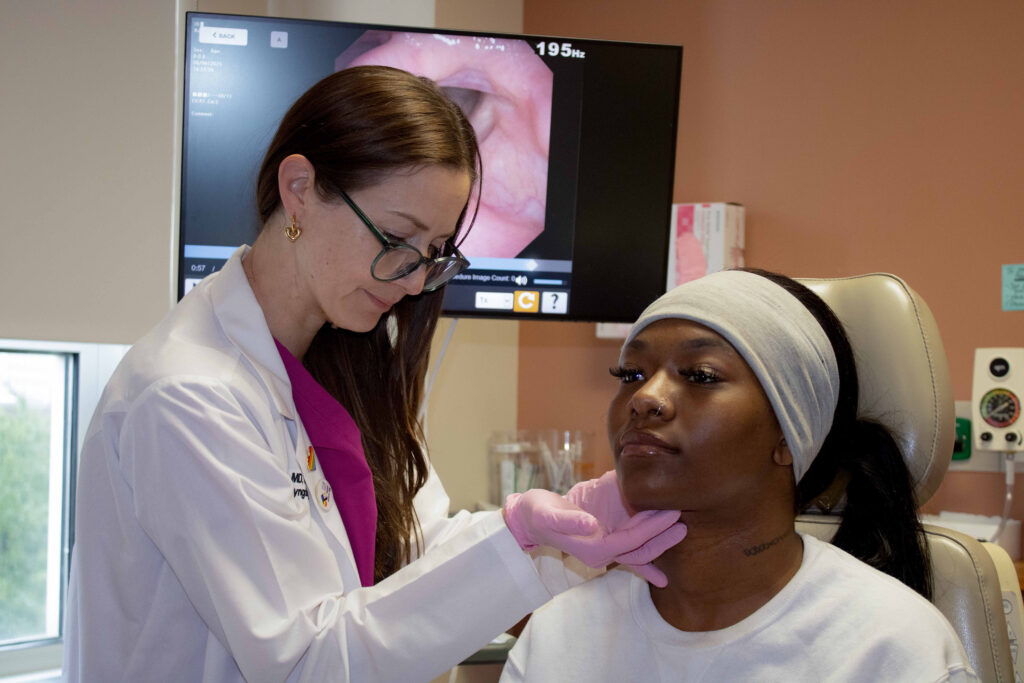
Of the many services the UPMC Voice Center provides, its voice care program is especially highly regarded and unique.
“We help the person find their most authentic voice,” said Leah B. Helou, PhD CCC-SLP, Director of Speech-Language Pathology at the UPMC Voice Center.
If a person’s voice is misperceived due to smoking or medication, they dislike their squeaky voice, or how their voice has changed with age, they may seek voice care.
Whatever the case, “it’s an important part of recognizing our shared humanity and experience in that we are all seeking to put out into the world how we feel, and voice is one way to display that externally,” said Nora Mahon, MS, CCC-SLP, one of the speech-language pathologists at the Voice Center. “Voice is something that people don’t always feel is in their control as a customizable feature of the self.” And many fail to realize that it is.
The voice program is multidisciplinary, with speech-language pathologists providing the majority of care. Since Chloe Santa Maria, MD, MPH, Director, Complex Adult Airway Center, arrived in 2024, the program now offers pitch-elevating. This surgery involves permanently altering the vocal cordmass, increasing the tension and reducing the amount of the vocal fold that vibrates. This structural change increases the pitch of the voice.
Surgery can only alter the pitch or fundamental frequency of the voice, and when it comes to identity and gender perceptions of voice, pitch is a very small piece of this bigger puzzle. Bigger pieces of the puzzle include resonance, word choices, cadence, and intonation, “which is what our talented speech-language pathologists work on in therapy,” Dr. Santa Maria said. “Vocal cord surgery also carries with it real risks of hoarseness, so it can be used as a helpful adjunct, but requires a very thoughtful approach and conversation between patient and provider.”
Dr. Helou and Mahon see this topic through a public health lens. Together, they founded the Vocal Congruence Project, through which they offer education to providers of voice training, resources addressing common barriers to care, and an international directory to connect clients and providers. They conduct outreach to community organizations, mental health professionals, and more, to get people connected to what is a vital but niche service.
Another unique aspect of the program is its holistic nature. Rather than focusing just on techniques, “we consider identity components and help people explore and achieve their own voice and vocal authenticity in its fullness,” Mahon said.
The program sees roughly 100 patients a year. People typically start with six appointments. Progress does not happen 45 minutes at a time, but in the hours of using the voice in between sessions. After six sessions, they should have the skills and tools to practice independently. Usually, they circle back at some point to discuss successes and challenges and get more help in targeting the issues. Some people may feel they obtained what they wanted in one or two sessions, while others may prefer to work with an SLP for a longer course to feel highly confident in their voice.
“We’re all on a lifelong vocal journey,” she added. “Our voice changes over time, and our vocal demands change over time. It always can be a moving target for people because of that.”
In speech-language therapy sessions, patients work on their pitch and how it interacts with the rest of the system. While there are structured exercises, a large part of the process is teaching people and giving them permission to play and explore with their voice.
“As soon as we give ourselves that permission to try different things, a lot of people realize they have flexibility that maybe they’ve never used before or weren’t familiar with,” Mahon said. “As soon as they turn their attention to it and become intentional about how they use and shape it, they might already be a lot further along than they thought. Our voice is a habit; we stay at a spot as our usual go-to every day, but we’re not stuck there. We have all this other space.”