The Eye & Ear Foundation’s October 9th webinar, “Bringing Hearing to the Greater Pittsburgh Community,” was presented by Catherine V. Palmer, PhD, UPMC Director of Audiology, Professor of Otolaryngology-Head & Neck Surgery, Professor and Chair, Department of Communication Science and Disorders, and Taylor Murray, AuD, CCC-A, Senior Audiologist at UPMC and Adjunct Faculty.
Hearing Loss is Under Recognized
There is a large group of people who have hearing loss. “We often say, if you live long enough, you will probably have hearing loss,” Dr. Palmer said.
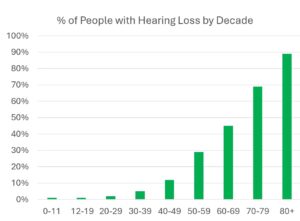
Talking about bringing care to the community implies there are some barriers to doing so. One of the barriers is identifying and recognizing that a person has hearing loss. A study done in Pittsburgh by Dr. Elaine Mormer found that only 40% of people who had “impactful hearing loss” actually recognized they did. When interacting with healthcare providers, only about 50% of those providers recognized the person they were interacting with had untreated hearing loss. This is largely because in the adult population, the majority of hearing loss is gradual and becomes the new normal. In brief healthcare encounters, the provider may not notice it.
Over 60% of people 65 and older have hearing loss. This would not be problematic if they were all receiving care, but they are not. About 18-20% of people with hearing loss pursue treatment, like getting hearing aids.
While the pediatric population is not a large group with hearing loss, it is very important that hearing loss be identified as it impacts their ability to develop speech and language, be successful in school, become employed, and have meaningful social interactions. Universal newborn hearing screening identifies hearing loss at birth. This program also identifies infants that are at risk for developing hearing loss so they can be followed.
Untreated Hearing Loss
Untreated hearing loss is associated with:
- Increased cognitive decline
- Increased risk of falling
- More vulnerable to depression
- Increased odds of social isolation, decreased social participation
- Increased risk of not following the doctor’s treatment recommendations and increased medical adverse events
- Increased hospitalization and readmission
All of these are reduced when hearing loss is treated.
Hearing care and hearing aids for children are 100% covered by the state of PA regardless of income – the only state in the country that does this. This means care is center based. Western PA has excellent pediatric audiologists at UPMC Children’s Hospital of Pittsburgh. While this is amazing care, time and travel can be barriers when care is center based.
When children turn 21, they no longer have the benefit of having hearing care financially taken care of as typically insurance will not cover hearing aids.
Hearing Aid Expenses
Dr. Palmer is periodically asked why hearing aids are expensive. She said they actually are not when you consider this in the context of a chronic condition. The average cost of hearing aids plus the care needed (fitting, programming, training) is about $4000/person, usually spent every 5-7 years. If an individual needs to pay this, of course it is very expensive. For many people, however, it is simply out of reach. That, however, does not mean hearing aids are expensive. It means hearing care is expensive and out of reach when an individual needs to pay directly; the problem is hearing care and hearing aids are not covered by insurance.
If you think of needing hearing aids due to a chronic condition (aging, hearing loss), and spending $4K to manage a chronic condition every 5-7 years, “that’s actually incredibly affordable compared to the kind of money spent to manage most chronic conditions,” Dr. Palmer said. This is especially affordable for the system at large given the negative impact when hearing loss is left untreated.
Hearing aids are excluded from Medicare, which means most other insurers do not cover them. An act of Congress would be required to change this but has yet to happen. In the UK and Australia, hearing aids are free for adults as part of the national health plan, yet only 40% of people access that care, showing that price is not the only barrier.
Accessibility
In the meantime, “we have to take care of people, and we do,” Dr. Palmer said. Accessibility is impacted by the need for assistance (others taking time off), time, trust, awareness/knowledge, distance, space, financial resources coupled with the lack of insurance coverage, and physical location.
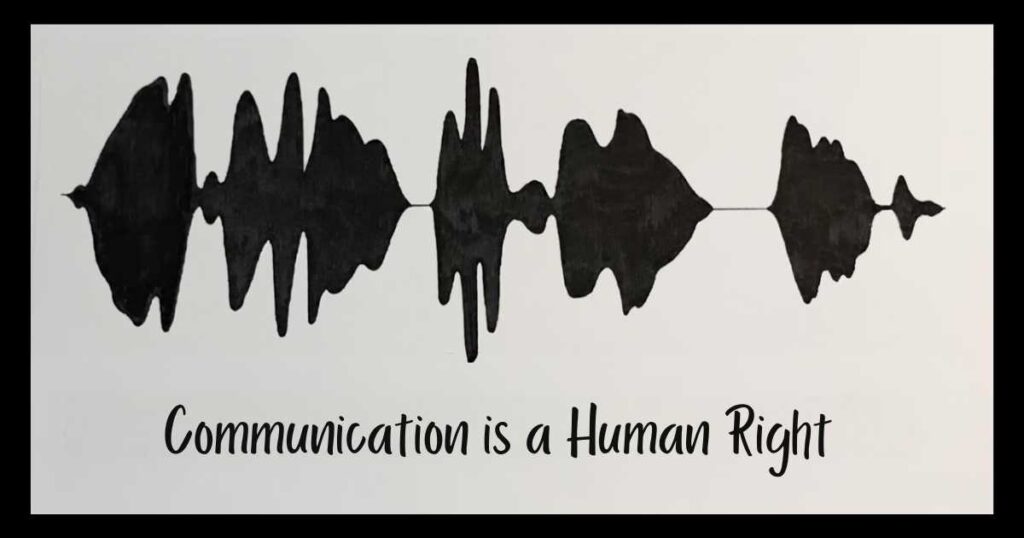
“To deal with some of these problems, our mantra always is: Communication is a human right,” Dr. Palmer said. Audiology has been embedded into other clinics. The idea is that the patient is already going to the gerontologist or in senior living. Why not have a clinic right there?
Telemedicine for hearing aid, tinnitus, and cochlear implant appointments means that people do not have to travel. A site – cleardashboard.info – helps people navigate over-the-counter hearing aids, also saving time. It also makes people feel like they can make some of their own decisions.
When audiologists are embedded into other clinics where there are already trusted professionals, that makes people feel comfortable with the care.
LiDiA, used in primary care clinics or at hospital geriatric appointments, can quickly screen people’s hearing. After identified, it turns into an amplifier.
“Free hearing care seriously takes a village,” Dr. Palmer said. The Eye & Ear Foundation is a huge part. Brother’s Brother is a large part in terms of the mobile unit. Pitt students and faculty, UPMC Audiology and ENT, and community partners make up part of the village. A lot of things have to come together in this ongoing effort. “We are really uniquely situated here in Pittsburgh to have all these pieces that fit together to let us have the programs we have,” Dr. Palmer said. “Nowhere else in the country runs the kinds of programs Dr. Murray’s running.”
Financial Barriers
Access is rarely determined by a single issue, and for many patients, several barriers overlap. Any one issue can delay care. Since every issue cannot be solved at the same time, Dr. Murray said they decided to start with financial barriers – usually the main concern the hearing healthcare industry hears about. Patients do not always have to just pay for hearing aids but have to anticipate costs related to follow-up care, missing time off work, and transportation. This leads to a delay in care, going without care completely, never entering the hearing healthcare system at all. “For us, the starting point was simple,” Dr. Murray said. “What can we do to open that door and keep that door open?”
Brick-and-Mortar Free Clinics
There are three brick-and-mortar free clinics: Birmingham Free Clinic, Squirrel Hill Health Center, and the University of Pittsburgh Community Engagement Center – Homewood. A team is sent once a month to the first two to deliver completely free hearing care that includes comprehensive hearing evaluations, hearing aid fittings, counseling, discussion on hearing loss, and follow up care. Patients who need amplification receive hearing aids at no cost.
“The full continuum of care is really important and special to what we do here in Pittsburgh,” Dr. Murray said. “That’s because we’re not just screening or identifying hearing loss. We’re looking to solve the problem and give patients a well-rounded experience in their hearing care.”
These brick-and-mortar locations give patients a place to talk about their hearing loss, understand the results, and receive the appropriate recommendations. Often, the audiologists see patients who want to have their hearing tested somewhere and the person they saw did not have the time to really explain and answer their questions. Patients also need help connecting their hearing aids to their phone – another huge technical component of hearing care. They need guidance and a place for them to return with questions.
Once the first two clinics were readily established, the Homewood clinic was offered. Services are provided there once a week.
All three clinics are used as teaching sites, largely run by the Doctor of Audiology students at Pitt. Students develop clinical skills and learn to listen to patients, communicate clearly, and adapt recommendations based on each patient’s circumstances. This enforces that audiology is not just technically accurate but also has to be practical for the person sitting across the room from you. If something impractical is offered, it is not going to work.
These clinics offer a point of entry to patient care. The ability to offer free care opens up the door that has been closed to a lot of people. It offers consistent community-based healthcare to patients who might otherwise not have access to it.
In 2026 (January-September), 155 hearing aids were dispensed. “This number shows that each device that we dispensed went to a person who can now better follow conversations, better communicate with family, and better communicate in work or community activities that maybe they weren’t able to do prior,” Dr. Murray said. “The number catches our volume but doesn’t fully capture the entire personal change made by each encounter.”
In 2026, most patients seen were in the 76–80-year-old group. Over 90, there was a significant drop off. Patients tended to be female and mostly white. The demographic data reflects communities that have been historically underserved and shows that reducing financial barriers can create a meaningful point of entry into hearing healthcare. The data also helps identify gaps. If a neighborhood or group is not represented, that prompts the question why. Looking at it this way, “the data is not only a record of what we’ve accomplished but serves as a tool to what we need to focus on next,” Dr. Murray said.
Mission of Mercy
The Department of Audiology has been participating in this annual two-day event since 2022, offering free hearing care services. In 2025, 408 hearing tests were performed, 320 people were fit with hearing aids, and 636 individual hearing aid units were distributed.
Since this is such a large endeavor, delivering this volume of care in 48 hours requires careful coordination. Even though it moves at an extraordinary pace, it shows that thousands of people seeking care in one weekend demonstrates how much of an unmet need hearing care is within the city.
There is always strong, consistent patient volume, with the free clinics often booked far in advance. All in all, the model works.
Mobile Care
Another concern the team encountered was patients calling for information about free clinics but not having a reliable way to reach them, as people are pretty spread out across the Pittsburgh area and the clinics are mostly central to downtown. The team started looking into other reasons why patients would not be coming in. Everything boiled down to transportation, which can seem like a simple logistical issue but affects every stage of care. A patient might not drive or may no longer feel comfortable driving far distances. They might depend on a family member who has a work schedule that might not align with clinic hours. Public transportation can require multiple connections, significant walking or travel for a long period of time for a relatively short appointment. Patients with mobility limitations will have more challenges getting home and navigating an unfamiliar building. Even if someone can make an initial visit, hearing loss requires a lot of follow-up care. “You don’t have to encounter that barrier once,” Dr. Murray said. It’s two, three, four times within a short period of time, and then for many years after. We’ve learned that making hearing aids and hearing care available to people doesn’t necessarily mean we made it accessible.”
This intersection of two significant needs: the need for free hearing care and the lack of transportation. The answer: the Communication Van. Rather than asking patients to overcome the transportation barrier, the Van removes much of that altogether. It brings a fully functional audiology clinic directly to neighborhoods and community spaces where patients live and organizations already thrive. “This is more than a change in location; it is really a change in how we define access in a traditional healthcare model,” Dr. Murray said.
Flexibility allows the Van to respond to local needs while still providing comprehensive hearing care. It also creates conversations and opportunities to explain what the audiologists are doing to people who might never have thought about them in their daily lives. A person may first hear about the Van through a trusted community organization, see the Van on the street, or learn from a neighbor that services are available nearby. “Each of these touch points can reduce uncertainty and make care more approachable,” Dr. Murray said.
The lack of space in the Van has forced the team to be thoughtful about what is absolutely necessary to run a fully functional clinic. It also forces the students – who primarily run this clinic – to be organized and efficient. “We’re not compromising care because we’re in a different space,” Dr. Murray said. “We’re going to do exactly what we would do everywhere else; we just have to be more efficient and effective as we do it.”
The Van is run rain or shine, in 95-degree heat, but not when it is too cold. The Van is co-managed by Dr. Murray and Dr. Ashley Parker. Due to the many complexities of running a mobile unit, Dr. Parker handles the Van logistics (like making sure the air conditioning works) and Dr. Murray runs the clinical side.
The Van has a wheelchair lift, which was part of the design. If the Van is in the right neighborhood but the patient cannot get in safely because of steps, the Van has not removed a barrier to care but moved the barrier to care, Dr. Murray explained.
Identifying Community Partners
The Van does not choose locations randomly. Each is evaluated carefully because making a successful visit requires more than just having a place to park. When community partners reach out, they are sent a detailed questionnaire asking:
- Location
- What are their community’s needs?
- Are they able to accommodate our van?
- Can they host us multiple times a year?
- How will this partnership impact the student experience?
Dr. Murray thinks the most important question is how many times the Van can be hosted, as returning to a site offers consistency, which builds trust. A lot of the communities the Van goes into lack trust for hearing healthcare. Returning gives community members time to learn about the program. Audiologists are also able to focus on follow-up care, which is truly important with hearing aids.
When sites answer the questionnaire and meet all the criteria, they become community partners. The Van has six active partnerships: Carnegie Library of Pittsburgh Beechview and Woods Run, Roots of Faith in Sharpsburg, University of Pittsburgh CEC in Hazelwood, Sheep Inc. in Penn Hills, and the Human Service Center of Mon Valley and Turtle Creek.
In 2026, the Van primarily did evaluations, hearing aid fittings, and follow-ups. The number of hearing aids dispensed was 152. These early results demonstrate the value of this approach, as it nearly matches the number of hearing aids dispensed at the free clinic sites. This is not to say that one model is better than the other, but that efforts are being focused in two great places. “We are able to offer services to people by removing these barriers,” Dr. Murray said. “I always like to think of it as the fixed clinics provide stable locations and continuity with established settings. The Van just extends that care into communities where transportation is a gap.”
The demographic data is more varied compared to the clinic sites. The age range is more variable, with a lot of people in the 66-75 age range. By looking at the gender and race categories, more people are being targeted than at the free clinics. But is this because the Van is going into these locations or communities where they are able to see more of these people, or is it just in these communities that patients have more of a barrier to transportation?
Patient Testimonies
Three patient testimonies:
“I don’t drive anymore. My daughter has to take off work to take me to my doctor’s appts. I didn’t want to bother her with another appt, so I’ve never had my hearing checked. I was so thankful when I learned I could walk to the [Communciation] Van!”
“I did everything right my entire life. I worked hard, owned a house, and lived within my means. But I had one string of bad luck and lost it all. I can’t afford to fix my car. I certainly couldn’t afford hearing aids. This has been life changing.”
“(in tears) I’ve struggled with ringing in my ears for over 10 years. No one has been able to help me because I can’t afford hearing aids. Thank you. Thank you. Thank you.”
Expansion Projects
A new initiative that just started is providing dedicated services for individuals with intellectual and developmental disabilities (IDD). This is a natural next step because members of this population may face several barriers like financial limitations, transportation challenges, and difficulty navigating. Research has shown that traveling to the clinic and sitting in a waiting room facing delays or navigating an unfamiliar environment can cause distress for someone with IDD. This, in turn, can adversely affect test results in terms of hearing care and outcomes. Using the Van to travel to these patients means maintaining the commitment to quality care but adapting how it is delivered so each person has a genuine opportunity to participate. While this is still in the very early stages, the response so far has been promising.
These populations don’t get to the university to be included in research, which means that their data are not included in the mix that helps those make decisions in terms of technical development and care. Dr. Palmer announced that she just received notification that the LEND (Leadership in Neurodevelopmental Disabilities and Other Rare Diseases) grant has been renewed. Audiology will have a piece of this, with Pitt faculty working on outreach into rural communities to support pediatric hearing care.
Support Needed
It costs money to run all of these programs. Follow up with Craig Smith at the Eye & Ear Foundation if you want to support this work (craig@eyeandear.org).