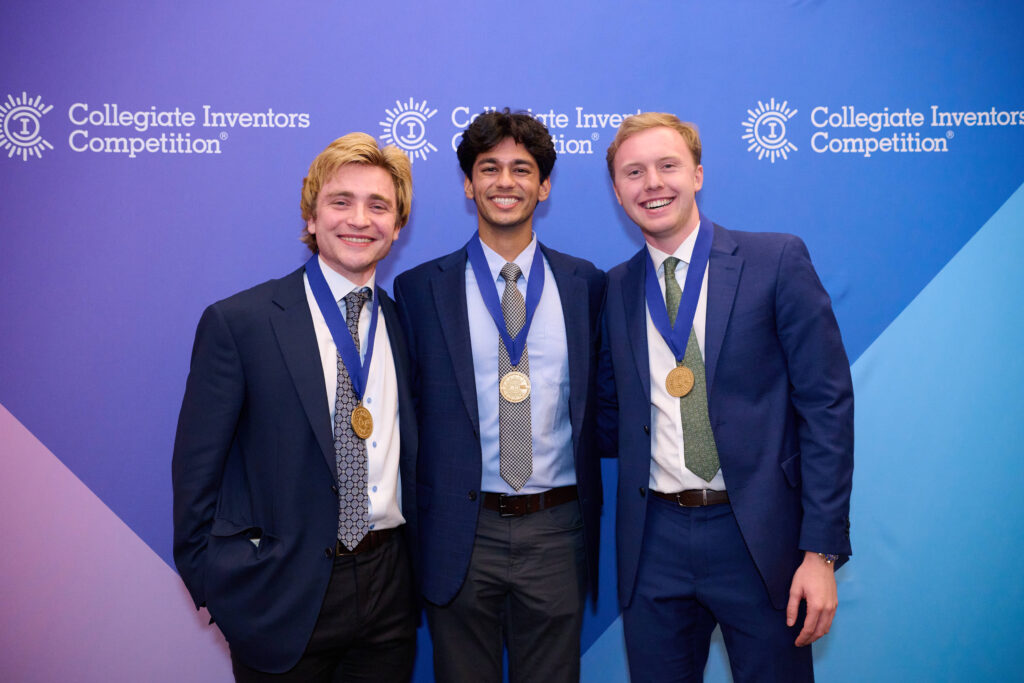
A University of Pittsburgh School of Medicine group is the graduate winner of the Collegiate Inventors Competition! Hosted by the National Inventors Hall of Fame, the Pitt group was one of five graduate teams nationally to be selected as finalists. They received an all-expenses-paid trip to Washington D.C. to attend the event at the United States Patent and Trademark Office (USPTO) headquarters in Alexandria, Virginia.
Their invention – ClearView-Jaw – is a new fixation plate for jaw reconstruction. As one of the three med students on the team, Zach Spears, explained, “When a patient has jaw cancer, surgeons will remove the impacted part of the jaw and use a titanium plate to hold the reconstruction together. This titanium plate is a potential driver of complications.”
ClearView-Jaw is a new plate design that replaces the current titanium plates being used. It is 3D printed and custom designed for each patient to ensure better radiation therapy delivery, better clarity on imaging, and better long-term outcomes.
Spears’ teammates are William McKay and Amogh Vellore. Interested in engineering, they found advisor Matthew Spector, MD, FACS, Professor, Department of Otolaryngology-Head & Neck Surgery, Division Chief, Head & Neck Surgical Oncology & Microvascular Reconstruction, with 3D printing. Anish Ghodadra, MD, Assistant Professor, Department of Radiology, Vascular & Interventional Radiology Division, was co-advisor.
For patients undergoing mandibular reconstruction after head and neck cancer surgery, the reconstruction plate is an essential part of restoring form and function.
“ClearView-Jaw represents an exciting new approach because it was designed specifically to address some of the limitations of traditional titanium plates, including interference with radiation therapy and imaging surveillance,” Dr. Spector said. “If successful, this technology has the potential to improve cancer treatment, reduce complications, and ultimately enhance quality of life for patients who have already endured a difficult journey through cancer treatment.”
In an introductory video, Vellore said, “The main thing that inspired us to make this invention is the patients. I hope that it makes their lives just a little bit easier after they get that hard diagnosis, and live happier, healthier lives while getting back to normal functioning sooner than they otherwise would have been able to.”
The students have been working on the device for the last nine months. They are still doing benchtop testing and are planning for a clinical trial. Now they have $10,000 and a USPTO Patent Acceleration Certificate to support their work and hopefully expedite it.
“I love inventing because it’s the ability to dream. It’s not an easy undertaking, but if you’re successful at it, you can make a huge impact for generations to come,” McKay said in the video.