Timing matters in survivorship care. A new study published recently in JAMA Otolaryngology-Head & Neck Surgery found that patients with head and neck cancer who began care in a multidisciplinary survivorship clinic before or early in radiotherapy had a lower risk of recurrence or death than patients who started after treatment.
“I think a lot of times survivorship care is seen as just something that is nice to have but is not essential,” said first and corresponding author Marci Lee Nilsen, PhD, RN, CHPN, FAAN, Director of the UPMC Head & Neck Cancer Survivorship Clinic. “This study shows that if we just shift survivorship care a bit earlier, patients have better outcomes.”
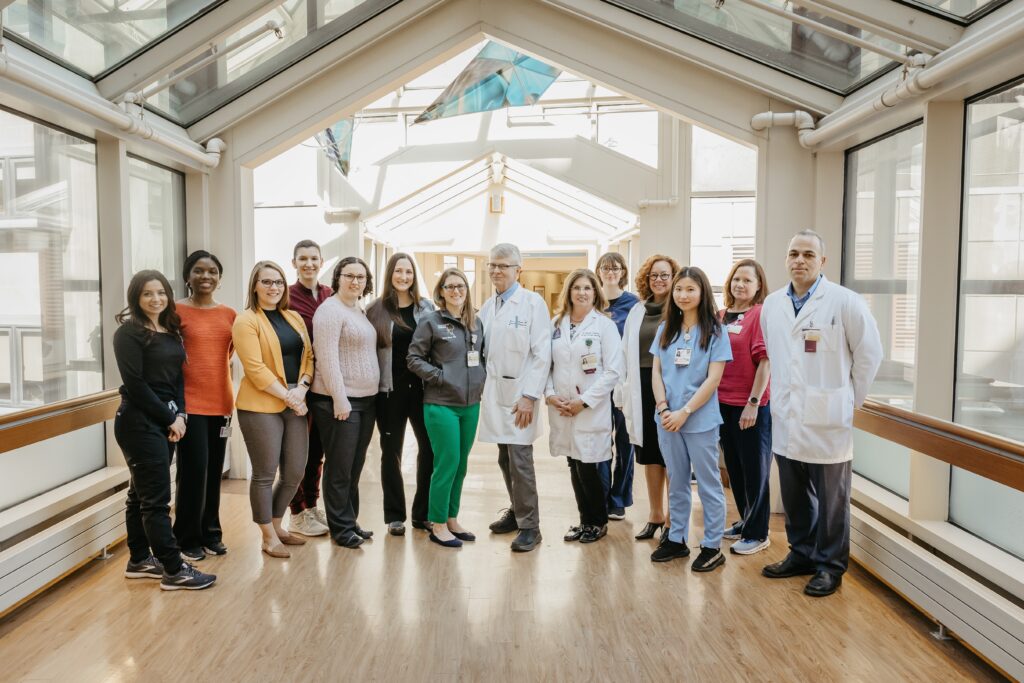
At the Survivorship Clinic, patients see a multidisciplinary team, including specialists in speech-language pathology, physical therapy, nutrition and dental care, in a single same-day visit ending with a treatment summary and care plan for the patient, as well as their oncology team and primary care clinician. Dr. Nilsen’s team previously showed that earlier survivorship care improved patients’ quality of life and psychological well-being. Building on these findings, she wanted to know if earlier intervention could also improve patients’ odds of surviving.
To investigate this, the researchers analyzed data from 471 head and neck cancer patients, 148 of whom received early survivorship care before starting radiotherapy. They found that patients who participated in early survivorship care significantly more likely to complete radiotherapy on schedule. Earlier care was also associated with a lower risk of recurrence and death three years after treatment, even after adjusting for treatment adherence. This suggests that the benefits of earlier care are not solely due to completing radiotherapy.
“This article confirms a longstanding assumption we had, which is that patients who go to survivorship do better,” said co-author Kevin Contrera, MD, MPH, Assistant Professor, Department of Otolaryngology-Head & Neck Surgery. “What is most notable is how much they do better and in ways that extend well beyond function.”
At the time of initial consultation, co-author Yvonne Mowery, MD, PhD, Associate Professor in the Department of Radiation Oncology and a radiation oncologist, encourages all of her patients with head and neck cancer to go to the Survivorship Clinic. “We are incredibly lucky to have this multidisciplinary research within the UPMC Hillman network,” she said. “I am excited that Dr. Nilsen is working to expand telemedicine access to members of the Clinic team after the initial visit for patients who live outside of Pittsburgh.”
Another co-author, Christopher T. Wilke, MD, PhD, Clinical Assistant Professor in the University of Pittsburgh Department of Radiation Oncology and Medical Director, UPMC Hillman Cancer Center – UPMC Shadyside Mary Hillman Jennings, reinforced the importance of multidisciplinary care. “True multidisciplinary care does not happen by chance,” he said. “It requires deliberate institutional investment, sustained collaboration, and a shared commitment to improving outcomes for patients with head and neck cancer.”
This study is among the first to show an association between timing of survivorship care and cancer survival. The results suggest that a relatively minor shift in care could have a significant impact on patients’ health outcomes.
“The association held up across multiple analyses, and even after accounting for treatment completion,” said senior author Angela Mazul, PhD, MPH, Assistant Professor of Otolaryngology at the University of Pittsburgh. “We now need a randomized trial to test whether moving survivorship care earlier truly changes outcomes, and to learn which parts of that care matter most.”
Dr. Nilsen said there is a growing population of cancer survivors who are being cured and living longer. “But a cure is not the only endpoint for survivors,” she added. “They want to live the best life they can. Survivors will tell you how beneficial it has been for them having survivorship care support along that journey.”

Leslye Hermann, 63, of Sewickley, PA, has tonsil cancer and was told about the Survivorship Clinic by her radiation oncologist. Her first visit was prior to treatment. She said it helped demystify the process of treatment and recovery and gave her some things she could do to prepare. If not for the Survivorship Clinic, for example, it would not have occurred to her to connect with her dentist to let him know about her diagnosis, much less schedule additional appointments to address the increased risk of tooth decay caused by treatment. She also likes that the Clinic provides an opportunity to participate in research and improve the experience of future patients.
When Hermann was waiting to see her surgeon, another patient came into the Survivorship Clinic. She heard him talking about how coming in is one of his favorite things to do; he likes connecting with everyone and the Clinic has been so helpful. “It was really neat to see his very positive reaction,” Hermann said. “I thought it was a nice testament to the effects of the program.”
Even though Hermann has only had two Clinic visits thus far, she already appreciates that there will be long-term involvement. She also likes that they told her, “As soon as you’ve been diagnosed and you’re surviving, you are a survivor.” She said, “Yeah, I am a survivor. I don’t have to wait to be through all this treatment to be a survivor. I thought that was inspirational and fit with the early start [at the Clinic].”

Bill Scholze, 59, from Verona PA, was diagnosed with throat cancer in 2023. At the time, the Survivorship Clinic was an experiment “that may or may not help some folks in the future.” Scholze immediately chose to participate and now calls it the smartest decision he could have made as starting survivorship care early made the most sense.
Scholze was told that he was about to undergo a difficult journey and that if he did not do anything he was supposed to be doing, it would be even harder. “They did not sugarcoat anything, which I’m very grateful for,” he said.
Week three of his treatment is when symptoms kicked in hard. “Without that survivorship knowledge ahead of time and going weekly and keeping me focused, I would have been lost,” Scholze said. “My wife said she would have been panicked and lost as well.”
He described the program as important because it allows the patient to get an idea of what is to come and provides them with the tools they need. He thinks it should be mandatory to have it be part of care from the beginning.
Scholze could not help but compare his journey to one of an old friend who received the same diagnosis a year earlier. He did not do the survivorship program and almost died of starvation. Meanwhile, Scholze did not want a feeding tube but calls being convinced to get it the wisest move he made. As a result, he stopped losing weight and dreaming about food and waking up in the middle of the night crying because he was hungry but could not eat. “I’m very grateful for the program,” Scholze said, “and I really wish my friend could have gone through the program as well because maybe he would be in better shape today as he’s still struggling.”
The Survivorship Clinic also helped Scholze’s wife Charlotte, who said they met her where she was. “They were a lifeline.”
Even though it has been three years since his diagnosis, Scholze still does his swallowing exercises. He uses what he learned from the clinic at least once a week. “It’s a lasting impact for sure,” he said.
Additional authors on the study are Katie Carlson, MPH, Maryanna Owoc, MD, PhD, Rida Ashraf, Jennifer Hetrick, Seungwon Kim, MD, José P. Zevallos, MD, MPH, Matthew Spector, MD, Kevin Contrera, MD, MPH, Yvonne Mowery, MD, PhD, Dan Zandberg, MD, Christopher Wilke, MD, PhD, and Jonas Johnson, MD, all of the University of Pittsburgh, UPMC Hillman Cancer Center, or both, and Motassem Bayyoud of Wright State University. This research was supported by the National Institutes of Health and the Gordon and Betty Moore Foundation through the Betty Irene Moore Fellowship for Nurse Leaders and Innovators.
Future studies will investigate how adjusting the timing of survivorship care affects cost and utilization, and the team has applied for funding to support a prospective clinical trial that will address these issues and further evaluate how timing affects oncologic outcomes.