When the Eye & Ear Foundation’s October 22nd webinar, “Everything You Need to Know About Angle-Closure Glaucoma” started, Rajesh Sasikumar, MD, Co-Director, Clinical Trials and Associate Professor of Ophthalmology, said, “I would also add, ‘And you were afraid to ask, or you didn’t know where to ask.’”
Why Angle-Closure Matters
Glaucoma is the leading cause of irreversible blindness. It is a slow and progressive disease. In 2020, 76 million people worldwide had glaucoma. Because people are living longer, this number is projected to increase to 112 million by 2040. About 20 million have the angle-closure form of glaucoma, which is less common than open-angle glaucoma, especially in the U.S. It, however, is more likely to cause people their sight – and much of that loss is preventable.
Angle-Closure in the U.S.
While there is no precise national count for angle-closure alone, the best U.S. study is the Chinese American Eye Study in Los Angeles, from which the following statistics were gleaned: 4.2 million Americans live with glaucoma of any type, while 1.5 million already have their vision affected. One in 78 Chinese Americans over 50 in Los Angeles had narrow angles or angle-closure. Three in four of those with angle-closure glaucoma in the study did not even know they had it. Only 1 in 3 Medicare patients who saw an eye doctor before an attack had their angle checked.
Open vs. Closed Angles
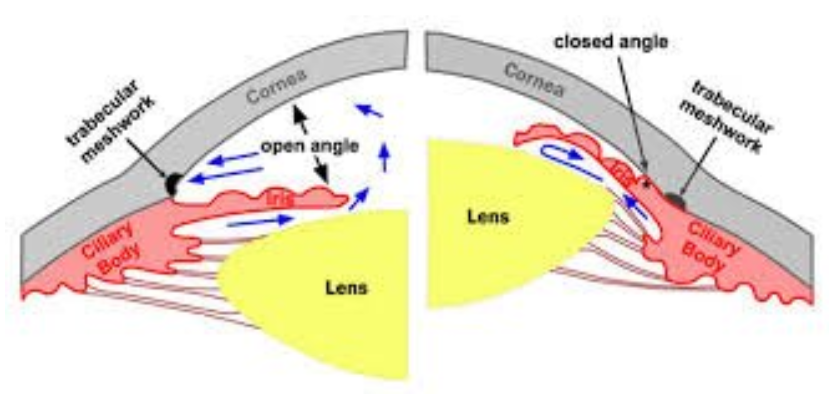
You can think of your eye like a faucet with a drain. How it works is this: a clear fluid is made constantly behind the iris, the colored part of the eye. It flows forward through the pupil into the front chamber, then drains out at the angle, where the iris meets the clear cornea.
If the drain cannot keep up, pressure rises and can damage the optic nerve, leading to glaucoma.
There are two ways a drain can fail. In open-angle – the type most people have heard of and the most common – the path to the drain is wide open but the filter itself works poorly, a bit like a sink drain that slowly gets clogged.
In angle-closure, the drain becomes blocked, like a rug pushed against a floor vent. It can happen slowly or all at once.
Why does the angle close? It usually comes down to crowding. A roomy eye has plenty of space in front of the iris, and the drain in the corner is wide open.
However, some other eyes are small and often farsighted. Our natural lens continues to grow thicker as we age, so by our 50s and 60s, it pushes the iris forward. If the space inside the eye is already small, fluid trying to get through the pupil gets held up behind the iris, which balloons it forward like a sail until it seals the drain.
Who is More Likely to Have It
- Age: Risk climbs after 40 as the lens thickens
- Ancestry: East Asian and South Asian heritage
- Women: Affected more often than men
- Farsightedness: Small, short eyes leave less room up front
- Cataract: A thick or forward-sitting lens crowds the angle
To put numbers on it, Dr. Sasikumar said, among adults 40 and older, roughly 1.1% of people of Asian ancestry have angle-closure glaucoma, compared with about 0.4% in European-derived populations. “If several of these apply to you, it’s worth asking your eye doctor specifically about your angles,” he added.
Two Faces of Angle Closure
Angle closure can occur as either a sudden attack, or in a chronic and gradual form. The attack is the form people tend to picture, when the drain shuts all at once. It is painful, dramatic, and an emergency. But this only happens to 1 in 3. More than 75% of people experience the silent and slow version, which has no symptoms, with side vision fading gradually, like open-angle glaucoma.
Warning Signs of an Attack
The warning signs of an attack include:
- Severe eye pain
- Blurred, foggy vision
- Red eye
- Headache, brow ache
- Halos around lights
- Nausea, vomiting
If you experience these symptoms, it is an emergency. Go to the emergency room or call your eye doctor right away because permanent vision loss can happen within hours. Watch for attacks after a new medicine, such as topiramate or pupil-dilating drugs.
Chronic angle closure takes side vision first, with no pain, no redness, and no warning. By the time people notice, the damage is advanced and permanent. This is why the eye exam matters.
Looking at the Angle
- The key test: gonioscopy, in which a mirrored lens rests on the surface of the eye so the drain can be viewed directly; takes a few minutes
- Imaging: Anterior OCT, a light-based scan that photographs the angle in cross-section, without touching the eye
- The full picture: Pressure and nerve, eye pressure, a look at the optic nerve, and a visual field test if needed
A routine glasses check may not include gonioscopy; ask for it.
Narrow Angles
A narrow angle is not yet glaucoma.
If you’re told you have narrow angles, it’s important to know where you are on this spectrum. A “suspect” has an iris that touches the drain over at least half its circumference, but with normal pressure, no scarring, and a healthy nerve. “Angle closure” means the drain is affected — pressure is up or the iris has started scarring to the drain — but the nerve is still healthy. “Angle-closure glaucoma” means the optic nerve has been damaged. Most suspects never progress, which is why treatment is tailored.
Laser
For decades, the standard treatment has been laser peripheral iridotomy, or a tiny bypass. A laser is used to make a very small hole near the edge of the iris, so fluid no longer has to squeeze through the pupil. The iris relaxes back and the drain opens. The procedure is done in the office in about 10 minutes, with numbing drops, usually in both eyes. It is the standard first step after an attack. Whether it slows long-term vision loss is still being studied. This is part of why lens surgery has become more prominent.
Lens Surgery
As the natural lens in the eye grows and becomes a cataract, it causes more and more crowding. The thick lens pushes the iris forward and seals the drain. This means that removing the cataract-lens and replacing it with a thin artificial lens — exactly the same operation as a cataract surgery – is a powerful way to open the angle. After surgery, there is room again; the iris lies flat and the drain is open. Increasingly, this is offered as a first-line treatment for the right patients, even if the cataract is still not causing significant visual changes. Alongside it, eye drops lower pressure, and for people whose pressure stays high, glaucoma surgery can create a new drainage pathway.
Two Big Trials
Two landmark trials shape treatment today, and together they explain the shift: Be selective with prophylactic laser and consider lens surgery early for people with real disease.
In the 2019 China ZAP trial, 889 people aged 50 to 70 with narrow angles had laser in one randomly chosen eye while the other eye was watched for six years. Laser roughly halved the risk, but the disease was rare, leading to the conclusion that laser for every narrow angle is not recommended.
In the 2016 EAGLE trial, run at 30 hospitals in five countries, 419 people with angle closure and high pressure or established glaucoma were randomized to cataract-lens removal or to laser plus drops. Lens surgery gave better quality of life and lower pressure at three years and was cost-effective. Now it is a first-line option.
Teaching Computers to Read the Angle
“One of the most exciting areas right now is artificial intelligence,” Dr. Sasikumar said. Pooling six studies with more than 5,000 patients, AI programs correctly flagged 94% of closed angles, checked against a specialist’s exam. This matters because gonioscopy takes a trained specialist, and most people never have it done. A quick scan read by a computer could one day bring angle checks to primary care offices, pharmacies, or community screenings.
Spotting a narrow angle is the easy part, however. Predicting which narrow angles will actually close is not yet an option; early models help but are not reliable enough to decide treatment. Repeat scans over time may be the key because eyes that narrow faster seem to be the ones at risk.
Questions We Still Can’t Answer
Despite progress, some big questions remain. “These are exactly where research support makes a difference,” Dr. Sasikumar said. “Answering these questions would let us treat the right person with the right procedure at the right time.”
- Who really needs treatment? Most narrow angles never get worse; we can’t yet tell which ones will
- Why do some eyes keep closing? In some eyes, the iris’ shape, not the pupil, blocks the drain, so laser alone is not enough
- Which treatment, for whom? Laser, lens surgery, or newer mini-surgeries: good evidence covers only some patients
- What do our genes tell us? Risk genes are known, but how they work and how medicines trigger attacks, is not
Dr. Sasikumar was involved with Singapore’s ANA-LIS laser trial for four years, helping learn which narrow angles get worse.
Five Things to Do This Year
- Get a full eye exam after 40, sooner if risk factors apply to you
- Ask: Are my angles narrow? Did you check them with gonioscopy?
- If they are, mention it before starting new medicines, including cold and allergy pills
- Know the attack signs and get same-day care
- Tell your family. Eye shape runs in families
“If I could leave you with one sentence,” Dr. Sasikumar said, “it’s this. Blindness from angle closure is largely preventable. We have the tools to find it, simple procedures to open the drain, and treatments to protect the optic nerve. What we need is for people to get looked at in time.”