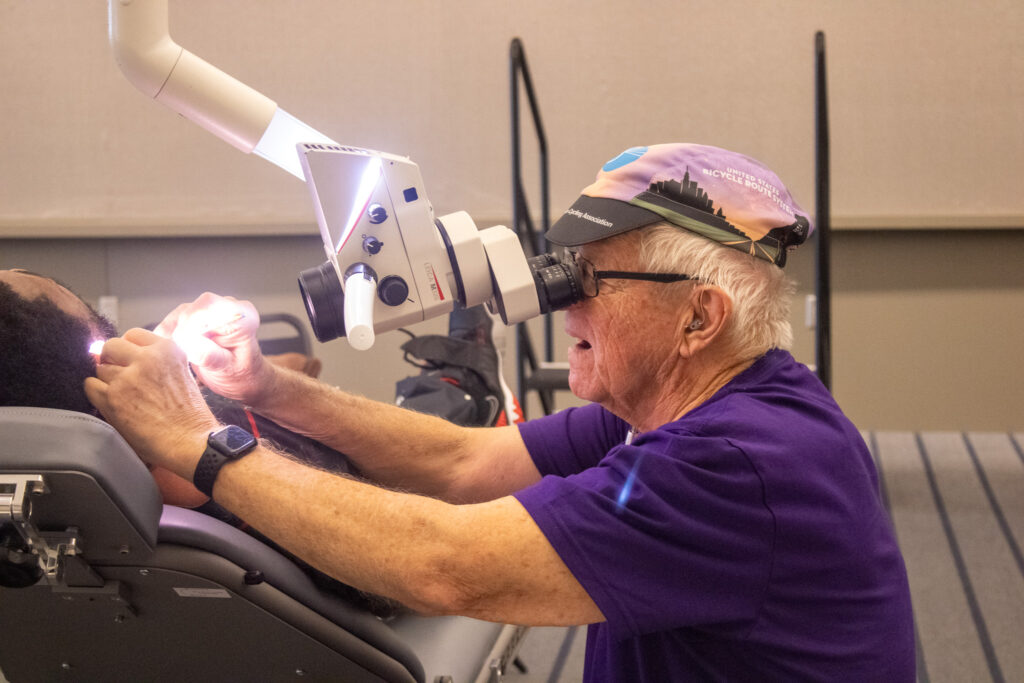
The Department of Otolaryngology-Head & Neck Surgery and UPMC Audiology participated in Mission of Mercy for the fifth consecutive year. The Eye & Ear Foundation, in partnership with Call to Care, hosted the two-day free dental and hearing clinic, held October 16-17, 2026.
“We completed more hearing tests and fit more people with hearing aids than ever before!” said Taylor Murray, AuD, CCC-A, Senior Audiologist at UPMC and Adjunct Faculty at the University of Pittsburgh who oversees outreach events related to hearing care.
These numbers represent so much more than the services provided, Dr. Murray added. “They represent individuals who can now better communicate with their loved ones, reconnect with the world around them, and experience an improved quality of life.”
One of the patients, Cynthia, described the event as “perfect, necessary, and meaningful.” She got hearing aids, along with a flu shot that she did not expect. “It almost makes me want to cry getting hearing aids I couldn’t afford,” she said. “I feel like I won’t miss out on conversations anymore.”
With support from at least 229 volunteers, the clinic conducted 487 hearing tests, fit 329 people with hearing aids (approximately 650 individual hearing aids were distributed), and provided otology care to 126 people. Undergraduate volunteers from the University of Pittsburgh, Penn State, and Duquesne University joined this year along with UPMC audiologists, otologists, and residents, University of Pittsburgh faculty, and alumni. A significant number of undergraduate students volunteered this year, and multiple volunteers crossed state lines to participate.
The Communication Van will be an important piece of follow-up care. For patients who received hearing aids at Mission of Mercy but are unable to come to the downtown clinic for follow-up care, Dr. Murray said, “we will try to connect them to the closest Van location to their home.”
Director of UPMC Audiology, Catherine V. Palmer, PhD, said from a volunteer perspective, she heard from many that this was the smoothest the clinic has ever run. “All the volunteers felt prepared and part of the larger effort,” she added. “We are now in a position where we have lots of returning volunteers as well as new helpers who will be experienced next year. Many undergraduates come and help at the orientation tables, and I heard from several of them that this experience has made them interested in audiology, which is exciting as well.”
Now that the Department of Ophthalmology has Community Vision Day (CVD) – a free vision clinic held throughout the year – they participated in Mission of Mercy by having a table where people could register for the CVD held at Mercy Pavilion on October 18th. Around 156 patients registered. Uninsured patients were also registered for 2027 mobile clinics closer to their homes, such as Washington County and Sharpsburg, so they could avoid transportation costs to the Hill District. “This will be our model for Mission of Mercy 2027 as well,” said Zeila Hobson, Community Ophthalmology & Remote Access Program Manager.
No patients were turned away, as in addition to registering patients for mobile clinics in their home boroughs, patients were registered for upcoming mobile clinics in the Hill District and Allentown. In general, Hobson said, an incredibly small portion of people were confused about the change with the Mission of Mercy clinics as Mission of Mercy stakeholders were thorough in updating their messaging. “Every patient that asked received the same explanation: we can better meet their needs with regularly scheduled clinics at the Vision Institute, and our mobile clinics span the entirety of Pittsburgh,” Hobson said. “The explanation led to the understanding that the lack of services at Mission of Mercy is not an indication of limited access to vision care. On the contrary, patients walked away with an appreciation for the expansion of no-cost vision services in the region.”
Of the patients who attended CVD on the 18th, 86% were from Mission of Mercy. According to Hobson, 117 patients were seen, 95 pairs of free glasses were ordered via Changing Life Through Lenses, and the no-show rate of 30-40% was relatively low compared to the institutional average of 50-60%.