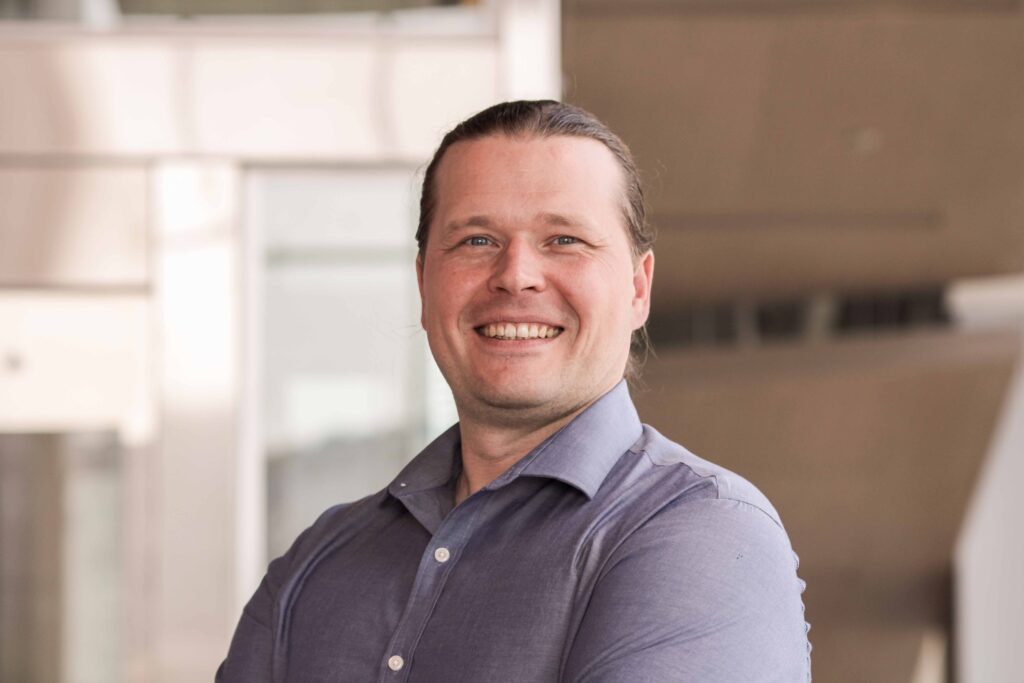
In Petr Baranov’s words, the Vision Institute is one of the few places in the world where optic nerve regeneration is a genuine institutional priority, not just an individual lab’s quest. The MD, PhD, who joined the Department of Ophthalmology as Associate Professor in February 2026, was drawn to Pittsburgh for this reason.
Previously Assistant Professor of Ophthalmology at Harvard Medical School and an Assistant Scientist at the Schepens Eye Research Institute of Massachusetts Eye and Ear in Boston, Dr. Baranov was also Associate Director of the Ocular Regenerative Medicine Institute and affiliated faculty of the Harvard Stem Cell Institute.
In Pittsburgh, the Louis J. Fox Center for Vision Restoration was the first comprehensive, multidisciplinary program in the country dedicated to ocular regenerative medicine, and optic nerve regeneration is one of its two central focuses, alongside whole eye transplantation.
Dr. Baranov called the caliber of the people here remarkable. “Dr. Larry Benowitz, one of the founding figures of the optic nerve regeneration field, joined the Fox Center to provide senior leadership, and the group includes Dr. Takaaki Kuwajima, whose lab works on protecting retinal ganglion cells and re-establishing their wiring in glaucoma and traumatic optic nerve injury, and Dr. Kun-Che Chang, whose lab combines gene therapy with stem cell-derived retinal ganglion cell transplantation,” Dr. Baranov said.
The Department is also a major part of the ARPA-H-funded THEA program — a multi-institution effort, with Pitt’s largest-ever optic nerve regeneration award, working toward a whole eye transplant that actually restores functional vision by regenerating the connection from the eye to the brain.
All this matters to Dr. Baranov, because his lab works on the other half of the same problem. “Dr. Kuwajima and Dr. Benowitz’s groups are expert at coaxing the surviving nerve fibers to regenerate and reconnect,” he said. “My lab grows replacement retinal ganglion cells from stem cells and engineers the retinal environment, so those donor cells survive, mature, and integrate. Cell replacement and axon regeneration are two halves of restoring vision after glaucoma and optic nerve injury — and doing them together, under one roof, is what drew me to Pitt. No other place has assembled this concentration of talent on this problem.”
The lab combines stem cell and retinal organoid biology with bioinformatics, deep learning, and automation. For example, they have developed computer algorithms that predict which stem cell-derived retinal organoids will differentiate successfully, outperforming human experts — as well as biomaterials and “development-like” microenvironments that help transplanted neurons survive, mature, and wire into the damaged retina. Dr. Baranov’s work has been supported by the National Eye Institute, the Department of Defense, BrightFocus, and the Gilbert Family Foundation.
His near-term goal is to establish his lab at the Vision Institute and advance their retinal ganglion cell replacement work toward the clinic. “Glaucoma alone affects millions, and there is currently no way to restore the vision it takes away,” Dr. Baranov said. “I also want to build collaborations across Pitt and CMU in imaging, gene engineering, and automated cell manufacturing, and to train the next generation of vision scientists. Long term, I’d like to help make Pittsburgh a destination for retinal regenerative medicine.”