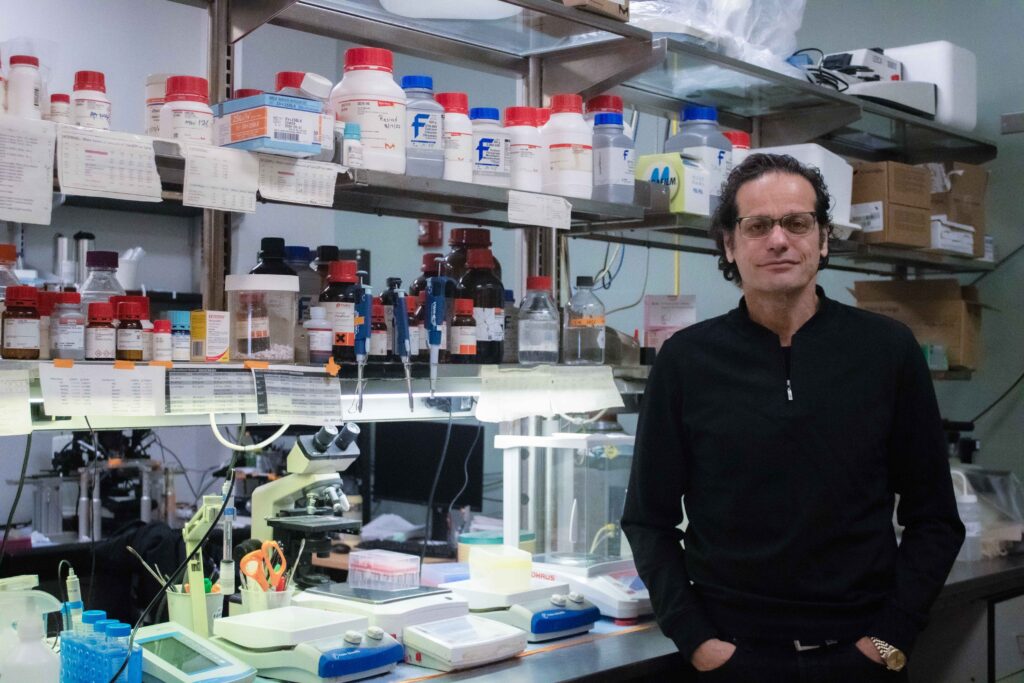
Two multimillion-dollar grants have been awarded to Thanos Tzounopoulos, PhD.
“These grants, awarded just in the last couple of months, do more than fuel my research,” said Dr. Tzounopoulos, Director of the Pittsburgh Hearing Research Center. “In my opinion, they show that the NIH remains the most effective, impactful, and sustainable engine for academic research, even after two years of uncertainty and worry for scientists.”
One grant, totaling $3.38 million, is being awarded from NIH/NIDCD (National Institute on Deafness and Other Communication Disorders) for “Synaptic, Cellular and Circuit Mechanisms of Cortical Plasticity after Cochlear Damage.” Dr. Tzounopoulos is the PI.
“Hearing loss causes the brain to boost its sensitivity to remaining sounds, which helps recovery but can also cause tinnitus and hyperacusis,” Dr. Tzounopoulos explained. “This project will uncover the mechanisms underlying these brain changes; and this understanding can help towards improving treatments and may also explain how the brain adapts to damage in other senses.”
The second grant, totaling $2.58 million, is being awarded from NIH/NIBIB (National Institute of Biomedical Imaging and Bioengineering) for “Next-Gen Fluorescent Indicators for Imaging Synaptic Zinc in Cortical Sound Processing.” This is a collaborative grant led by Drs. Tzounopoulos and Huiwang Ai at the University of Virginia.
“Zinc does more than stabilize proteins,” Dr. Tzounopoulos said. “Many neurons also release it at their connections, where it fine-tunes communication and sound processing, as our new zinc-sensing tools revealed. This project will build better zinc sensors to show how that release helps the brain adapt to changing sounds.”