The July 15th Eye & Ear Foundation webinar, “Recent Innovations in Vestibular Physical Therapy,” was presented by Susan L. Whitney, DPT, PhD, NCS, ATC, FAPTA, Professor in the Departments of Otolaryngology-Head & Neck Surgery and Physical Therapy at the University of Pittsburgh. A couple of weeks ago, the journal Frontiers in Rehabilitation Sciences did a systemic review of databases from 2014-2024 to see who was doing the most work on vestibular rehabilitation. The University of Pittsburgh ranked first in publication quantity, and Dr. Whitney was listed as the most productive researcher. “We’re making a dent in the world,” she said.
Physical Therapy
What is the main treatment tool for people with vestibular disorders? It is not drugs or medicine. Occasionally people have surgery, but physical therapy is most prescribed with specific exercises targeted to improve people’s function.
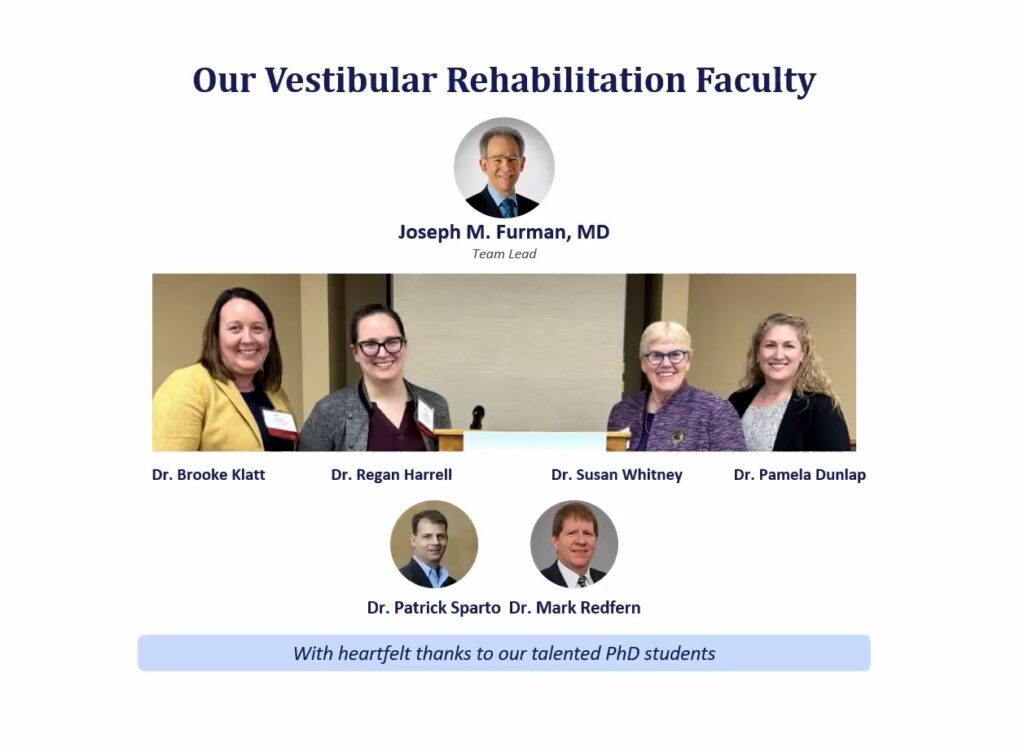
The team at Pitt has educated a number of physical therapist PhDs who are now around the world trying to advance the care of people living with balance and dizziness problems. Several continue to work with the Pitt team on projects as they advance their careers locally in their countries.
Clinical Practice Guidelines
Dr. Whitney has contributed to clinical practice guidelines, which are written by a multidisciplinary group of people to try and improve care. Initially published in 2016 and then in 2021, they will start work on the third update on the practice guidelines for vestibular rehabilitation for persons with damage to one or more inner ears.
VDR Gain Adaptation
“Your ear is just exquisite in terms of how it works,” Dr. Whitney said. She described turning your head like a pendulum or seesaw. If you turn your head to the right, a signal goes up in the right ear and down in the left, and vice versa. If the gain is one, that means it is reciprocal, or perfect. When there is an injury to the inner ear, however, this does not work.
Physical therapy attempts to change the gain or allow the injured ear to have a better signal, so the eyes and ears work together better.
An inner ear problem means the ear is not giving the correct signal, so as a result, the eyes sometimes jump or one can see nystagmus (a lot of eye jumping). Inner ear damage can cause people to have blurred vision or be dizzy.
“We try and change the game, so people feel better,” Dr. Whitney said of physical therapy. “We’re learning that timing is critical.”
A study in 2025 in mice found that ultra-early rehabilitation training within the compensation window significantly enhanced vestibular compensation. While this is in mice, Dr. Whitney said they think it is true in humans too. Early referral and therapy appear to get much better results than later referrals for therapy.
Improving Science
One tool in physical therapy is an exercise where people look at targets and move their head from side to side. Speed and background can be changed. While this is basic, it has become more sophisticated as the field learns more about how to help people.
One of Dr. Whitney’s friends in Canada developed a visual vertigo analog scale that helps therapists quantify how quickly a patient will improve. People that are very visually sensitive will take longer to get better.
“We are always looking at trying to make people more efficient, both for the person living with a vestibular disorder and the medical community,” Dr. Whitney said.
Dr. Whitney worked with Dr. Hoppes, a former PhD grad from Pitt, to change the visual analog scale. They collected data on over 200 people and came up with a shorter scale and tried to improve it as well.
Visual Symptoms
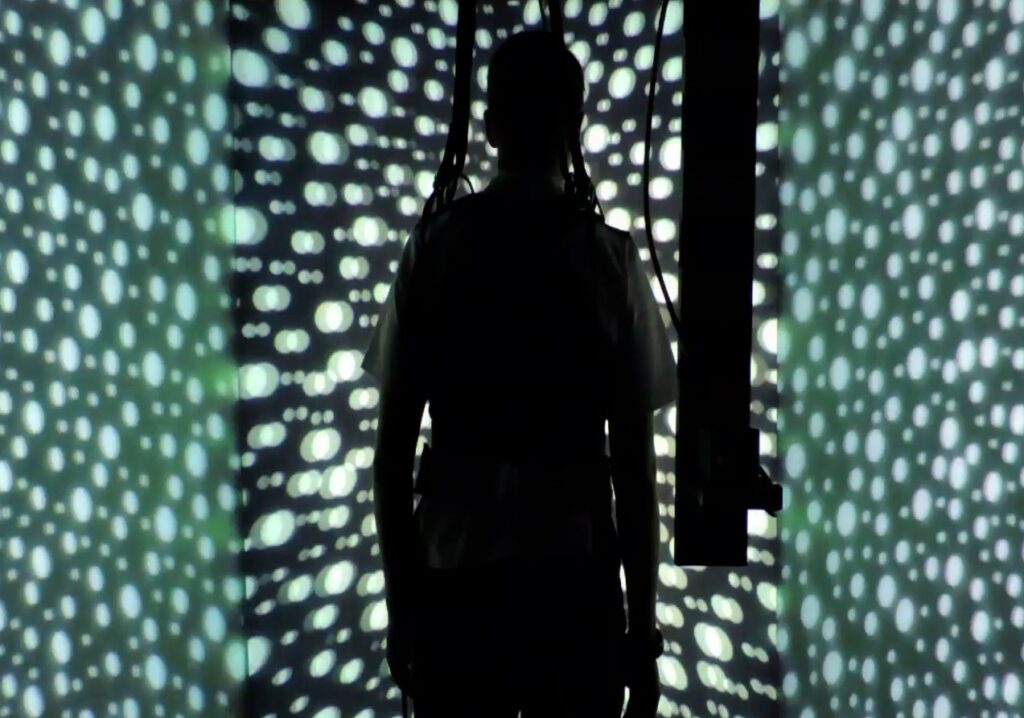
Over the years, the team has been trying to study what happens with visual symptoms because people are really visually sensitive sometimes after an inner ear problem. In a study published 4-5 years ago, the team thought people who were visually sensitive would be very uncomfortable standing in a room with LED dots that were moving. They were uncomfortable, yet the blood flow to the person’s brain did not light up in the hypothesized area. They are trying to learn more about what is happening in people’s brains to determine how to teach the brain to manage when the inner ear system is not working properly.
“Science has really improved,” Dr. Whitney said.
Dr. Pamela Dunlap, as part of her PhD journey, studied whether mobility could be predicted after an inner ear injury based on questionnaires at baseline. Baseline activity and participation and depression were associated with three-month mobility. Fear avoidance beliefs at baseline were also associated with three-month activity and participation. In other words, anxiety and depression were important predictors of how fast someone will improve.
The team is now trying to study this phenomenon within a large health system. The Balance Disorders Center at Eye & Ear is specialized and considered tertiary care, where patients typically have had symptoms for longer. The next step is to see what happens in a general care community setting.
Physical therapy tries to shift senses. When people have an inner ear problem, what happens is they rely more on their feet and eyes to keep their balance.
A group in Germany and then China have studied shifting of the senses. In China, they looked at MRI findings and people’s self-perceived dizziness. At Pitt, patients always fill out the same questionnaire called the dizziness handicap inventory. In people who had better perceived dizziness after a four-week rehab program, their cerebellum (the balance center in the back of the brain) lit up. Because of this paper out of China, the Balance Center got a $1.2 million grant that they executed in San Antonio with the military, using Praxis, which is a novel virtual reality system they developed.
Praxis
For people with mild traumatic brain injuries, rapid head motion can lead to symptoms like headache and dizziness. By immersing “warfighters” in a virtual environment, physical therapists use Praxis to guide them through a series of clinical exercises that gradually introduce increasingly challenging conditions. Virtual scenarios mimic head and body movements of traditional rehab exercises but also target different areas of cognitive ability to match the demands of their operational jobs.
As the person plays the virtual reality games, the software allows the physical therapist to see what they see. Analytics are recorded and patient reported outcome measures are collected directly so both parties can discuss symptoms and progress.
Praxis is currently undergoing validation trials at Brook Army Medical Center, where it will soon be an integral tool in therapists’ return to duty determinations.
Praxis was used on 30 people in the ROTC program at Pitt. The team is trying to see if it can be used in the NFL with people after a concussion or mild brain injury because spatial awareness is one of the things that can be involved when there is an inner ear problem. Even thinking can be affected after an inner ear injury.
Dr. Whitney announced that the day before the webinar, a paper was accepted about Praxis. The Balance team came up with the idea, and bioengineers and computer scientists developed it for us. She called it “really exciting.”
VestAid
About 7-8 years of work on Dr. Whitney’s part, along with Dr. Pedram Hovareshti and the crew at Blue Halo, has resulted in VestAid, a tablet-based technology.
Home exercise programs are an integral part of vestibular rehab. A major component is the adaptation of the vestibulo-ocular reflex and habituation training. Presently, there is no way to track if patients do the home exercise program or if they do the exercises correctly. In a partnership with the US Army Medical Research Program and Material Command, Blue Halo has developed VestAid to be used at home or in the clinic.
Physical therapists can easily adapt VestAid to meet the patient’s needs. Short video files teach patients how to perform their exercises, which can be reviewed at any time. Head and eye motions are captured, and the physical therapist is provided with precise information about gaze targeting, head speed compliance, and recording of the performance. The patient provides symptom ratings to help gauge exercise changes. A gamified reward system incentivizes patients to adhere to their exercise regimen.
Now there is data from 25 people and another 20 from a subsequent Department of Defense grant. Therapists can now tell if patients did their exercises, what time they did them, or whether they did them at all. Dr. Whitney is working on several papers related to the use of VestAid.
“The whole idea is through telehealth, we may be able to advance your care quicker because we know how well you’re doing or how poorly you’re doing so that we can modify your exercises,” Dr. Whitney said. “If you are less symptomatic, we can more aggressively have you work at home harder to get you better faster.”
BPPV Updates
BPPV stands for Benign Paroxysmal Positional Vertigo, though Dr. Whitney said this is misleading because it is not benign. Some people die from BPPV if they fall and hit their head or break their hip. About eight authors from around the world, including Dr. Whitney, wrote a short paper published in February’s issue of Neurology suggesting a name change to PPPV. They suggested changing the name from benign to peripheral.
Vestibular Agnosia
Dr. Harrell and Dr. Whitney are helping write the Barany position document about vestibular agnosia, which is when someone has loose crystals but does not know or feel a sensation of spinning or dizziness.
Dr. Harrell published a paper in 2022 from a study done at UPMC Mercy. Of the 76 people in the neurotrauma unit, 42 had BPPV, but only 4% of them could tell anyone they were dizzy. They had BPPV but were not reporting it. When people have loose crystals, they are at higher risk for falling.
One of Dr. Whitney’s friends in the UK published a paper in 2024. In the UK, it takes a long time to be seen due to their medical system. The falls clinic had 404 people on the waitlist, with 109 testing positive when asked questions about BPPV. If the BPPV is fixed, perhaps their falls will decrease. The waitlist went down by 25% and the five questions that they used to determine if a person had BPPV were 95% sensitive, which means that the questions used identified BPPV.
Having loose crystals increases the odds of falling. By getting loose crystals fixed, falls decrease, along with the fear of falling. Dr. Whitney wrote a 2023 paper that was a commentary on the world guidelines, saying all adults 60 years and older with balance problems should be screened for BPPV even if dizziness is not reported.
Physical Therapy IS Helpful
A 2023 study by Dr. Marmor found that physiotherapy within three months of an initial visit for dizziness was associated with an 86% reduction in fall risk over the next nine months.
“That’s huge,” Dr. Whitney said. “We want to keep people off the floor. No one wants to fall.”
Dr. Whitney continues to work with the Barany Society to improve care globally. Along with people from at least four different continents, she is working on a publication about what physicians and physical therapists should know to be competent as well as become an expert in the care of people with vestibular disorders. They are collecting all kinds of information and papers that are freely accessible to clinicians globally to be able to learn about the condition and recognize vestibular disorders.
“In summary, these are exciting times in vestibular rehabilitation happening here at UPMC and Pitt with the support of the Eye & Ear Foundation,” Dr. Whitney said.